
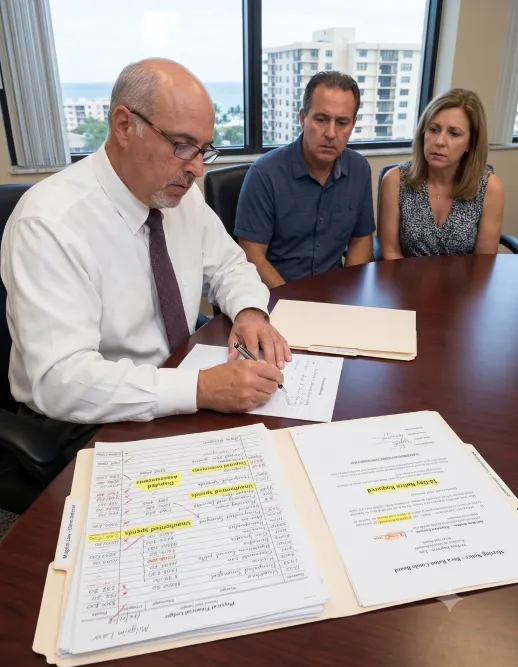
You open your mail, and there it is: a surprise bill from your condominium association for $25,000, $50,000, or even $100,000. The board claims it is an emergency special assessment, and they want the first installment within 30 days. If you are a condo owner in Miami, Boca Raton, or Naples, this scenario has become an all-too-common nightmare.
With post-Surfside safety laws hitting full maturity, Florida condominium boards are passing massive capital demands to cover decades of deferred maintenance. But just because a board claims an assessment is mandatory does not mean they followed the law to levy it.
Key Takeaways: Your Assessment Rights at a Glance
The Core Legal Right: Under Florida law, condominium owners have the absolute right to challenge any special assessment that was passed without strict adherence to statutory notice requirements, procedural bylaws, or authorized spending limits.
The Board Limit: A condo board cannot legally levy a special assessment behind closed doors, commingle those funds with general operating accounts, or spend the money on any project other than the exact purpose stated in the official 14-day advance written notice.
Immediate Action Step: If you receive a questionable assessment notice, immediately submit a formal written certified records request to the association demanding the itemized Structural Integrity Reserve Study (SIRS), the specific board meeting minutes where the vote occurred, and the detailed vendor bids used to justify the cost.
What Are Your Legal Rights When a Florida Condo Board Imposes an Unreasonable Special Assessment?
Your primary legal rights allow you to challenge the procedural validity of the assessment, demand absolute financial transparency, and legally dispute an association’s misuse of emergency assessment powers. Under Florida Statute Chapter 718, a special assessment is only legally enforceable if the board strictly satisfies heightened statutory notice requirements and acts within the scope of their explicit authority.
If your board fails to provide a proper 14-day written notice, holds the vote during a closed session, or fails to state the specific purpose of the assessment in the notice, the entire financial levy is legally voidable. Furthermore, under the sweeping reforms of the Florida Condo Owner’s Bill of Rights, boards face severe penalties if they try to hide underlying structural reports or line-item expenses from the unit owners who are footing the bill.
- ┌────────────────────────────────────────────────────────┐
- │ GROUNDS TO CHALLENGE AN ASSESSMENT │
- ├────────────────────────────────────────────────────────┤
- │ ❌ Failure to provide a full 14-day written notice │
- │ ❌ Commingled funds or spending on unstated projects │
- │ ❌ Lack of proper structural engineering backing │
- │ ❌ Voting in executive/closed board sessions │
- │ ❌ Violation of caps set in your Association Bylaws │
- └────────────────────────────────────────────────────────┘
How Do 2026 Legal Shifts and HB 913 Impact Special Assessments?
The 2026 legal landscape completely eliminates a board’s ability to waive structural reserves, meaning special assessments are frequently mandatory but must comply with strict statutory guardrails. Following the full implementation of House Bill 913 (Chapter 2025-175, Laws of Florida), associations can no longer skip or reduce funding for the critical structural components identified in their mandatory Structural Integrity Reserve Study (SIRS).
This regulatory squeeze has forced an unprecedented wave of special assessments across Palm Beach County, Broward County, Pinellas County, and Miami-Dade County. However, while the law demands safety, it also provides specific Consumer Relief Valves that rogue boards frequently try to hide from owners to maintain absolute control over the community’s finances:
- The Two-Year Funding Pause: Under HB 913, an eligible association that completed a milestone inspection within the past two years can, by a majority vote of the total voting interests, temporarily pause or reduce their SIRS reserve contributions for up to two consecutive annual budgets. This allows owners a vital breather to pay for active structural repairs without simultaneously being crushed by defensive reserve funding.
- Financing and Credit Alternatives: Boards are not legally required to demand massive lump-sum cash payments from owners. HB 913 explicitly confirms that associations can fund required structural repairs through lines of credit or long-term bank loans with majority owner approval, spreading the financial impact over years rather than days.
Parallel Enforcement Squeezes in 2026
It is worth noting that this aggressive wave of board overreach isn’t just happening in the realm of building structures. In a parallel regulatory arena, consumer rights are facing similar flashpoints. For instance, following the May 22, 2026 HUD Policy Reversal, federal agencies narrowed their administrative enforcement focus strictly to trained service animals. Unscrupulous Florida condo boards immediately jumped on this news, falsely believing they could start aggressively targeting, harassing, or imposing arbitrary rules on emotional support animal (ESA) owners.
But just as Florida Statute § 760.27 completely overrides that federal enforcement shift at the state level to protect ESA owners, Florida’s strict condominium statutes protect owners from arbitrary, procedurally defective financial assessments. When a board panics under regulatory pressure, they tend to cut corners—and that is exactly where a seasoned consumer advocate takes the fight to them.
The Legal Boundaries of “Fenced” Funds: What Your Board Can and Cannot Do
A condo board cannot treat a special assessment like a flexible slush fund. The law creates an iron-clad concept known as “fenced funds.”
| Special Assessment Rule | What the Law Requires |
| The Notice Declaration | The written notice of the budget meeting must state the specific purpose of the special assessment. |
| The Spending Lock | Funds collected can only be used for the exact purpose stated in that notice. |
| The Surplus Return | If the project is completed and money is left over, it must be returned to the owners or credited against future regular assessments. |
If your board passes a special assessment to fix the roof of a building in Fort Lauderdale or Hollywood, they cannot legally divert $50,000 of that money to remodel the clubhouse lobby or pay for routine landscaping shortages. Doing so is a direct breach of fiduciary duty.
How to Fight an Unreasonable or Unlawful Assessment: A Step-by-Step Guide
If your association is hitting you with an assessment that feels unjustified, excessive, or procedurally broken, do not simply throw your hands up or stop paying. Escaping an illegal assessment requires strategic documentation.
- Submit a Formal Certified Records Request: Immediate Action.
Under Florida law, the association must provide access to official records within 10 business days. Demand the full engineering or SIRS report, all competing contractor bids (minimum of three are typically required for large projects), and the signed board meeting minutes.
- Audit the Notice and Voting Procedure: Analysis Phase.
Verify the timeline. Did the board mail or hand-deliver the meeting notice at least 14 days in advance? Was the notice posted conspicuously on the property? If the board skipped this heightened notice and voted during a standard 48-hour notice meeting, the assessment is invalid.
- Review the Association’s Governing Documents: By-Law Check.
Read your specific Declaration of Condominium. Many older declarations contain explicit spending caps. For example, a declaration might state that the board cannot pass any capital improvement project exceeding 5% of the annual budget without an explicit majority vote of the entire unit membership.
- Pay Under Protest and Engage Counsel: Defense Execution.
Never simply withhold your assessment payments; doing so gives the board the legal right to slap a lien on your condo and initiate foreclosure. Instead, pay under written legal protest while Attorney Milgrim issues a formal dispute or files for emergency arbitration to challenge the assessment’s validity.
Protect Your Home with an Owner-Focused Advocate
Condo boards wield enormous power, and they have corporate law firms on retainer financed by your own assessment dollars. When they cross the line into illegal budgeting, procedural violations, or unauthorized spending, you need an aggressive partner to level the playing field.
At The Law Offices of Herb M. Milgrim, P.A., we do things differently. We maintain a strict, unyielding law firm policy: we exclusively represent individual Condo Owners and Homeowners. We NEVER represent HOAs or Condo Boards. We know the procedural shortcuts boards take, and we know exactly how to use Florida’s strict statutory framework to protect your equity and your property.
We actively protect consumers against board overreach across Florida’s primary residential and high-rise markets, including:
- Southeast Florida: Miami, Fort Lauderdale, Boca Raton, Palm Beach, Hollywood, Hallandale, Sunny Isles, Aventura, Pompano
- Southwest & Gulf Coast: Naples, Sarasota, and Pinellas County
If your association has levied an outrageous or legally suspicious special assessment against your home, do not wait for a lien notice to arrive. Contact us today through our website at The Law Offices of Herb M. Milgrim, P.A. to schedule a legal evaluation of your case.
Frequently Asked Questions
1. Can a condo board levy a special assessment without a vote from the owners?
Yes, in many cases. Unless your specific Declaration of Condominium explicitly restricts the board’s spending power or requires membership approval for capital expenses above a certain dollar threshold, the board of directors has the authority to vote on and pass a special assessment during a properly noticed meeting.
2. What happens if I simply refuse to pay a special assessment?
Withholding payment is dangerous. Under Florida Statute Chapter 718, the association can charge interest, levy late fees, suspend your right to use common amenities, place a physical lien against your unit, and ultimately foreclose on your condo—even if the underlying assessment is legally flawed. Always consult an attorney about paying under protest instead.
3. Is there a statutory limit or “cap” on how much money a board can assess?
Florida statutory law does not impose a maximum dollar cap on special assessments. The financial limit is dictated solely by your building’s actual structural needs (such as mandatory SIRS compliance) and any specific operational restrictions written into your association’s unique governing bylaws.
4. Can special assessment funds be used to cover standard budget shortfalls?
No. Special assessment funds are legally strictly “fenced.” They can only be spent on the explicit, specific project or emergency outlined in the 14-day notice sent to the owners. If the board needs extra money for general operating costs like insurance premiums or security, they must pass an amended annual budget instead.
5. How much advance notice must a board give before voting on an assessment?
Florida law demands a heightened notice period. Written notice of any board meeting where a special assessment will be considered must be mailed, hand-delivered, or electronically transmitted to every unit owner, and posted conspicuously on the property, at least 14 days before the meeting.
6. What is the difference between a regular assessment and a special assessment?
A regular assessment is your predictable, recurring monthly or quarterly maintenance fee calculated as part of the association’s annual operating budget. A special assessment is a separate, one-time or structured fee levied outside the annual budget to address an unexpected expense or an emergency infrastructure project.
7. Can a board pass a special assessment to fund a brand-new luxury amenity?
This depends entirely on your declaration. Many condo documents distinguish between “necessary maintenance” (which the board can usually fund independently) and “material alterations or capital improvements” (like building a new dog park or valet entrance), which frequently require a 75% approval vote from the entire membership.
8. My board says the assessment is an “emergency” so they skipped the 14-day notice. Is that legal?
True, unmitigable emergencies (like a main water line bursting or severe hurricane structural damage that threatens immediate safety) can allow a board to act quickly. However, boards frequently abuse the “emergency” label to bypass notice rules for predictable, long-term maintenance projects. If they fake an emergency, the assessment can be legally challenged and overturned.
9. What should I look for in the contractor bids if I suspect board kickbacks?
Under the Florida Condo Owner’s Bill of Rights, you have a right to full financial transparency. Audit the records to ensure the board obtained multiple independent bids. Look out for unitemized, vague “lump sum” invoices, bids from companies owned by a board member’s relative, or contracts signed without a formal board vote recorded in the official meeting minutes.
10. Can a buyer back out of a purchase if a special assessment lands during closing?
Yes, depending on your sales contract. Under updated consumer protections from the U.S. Department of Housing and Urban Development, buyers have explicit rights to review property documentation. Standard Florida real estate contracts also dictate whether the buyer or the seller is financially responsible for assessments levied prior to the closing date.