
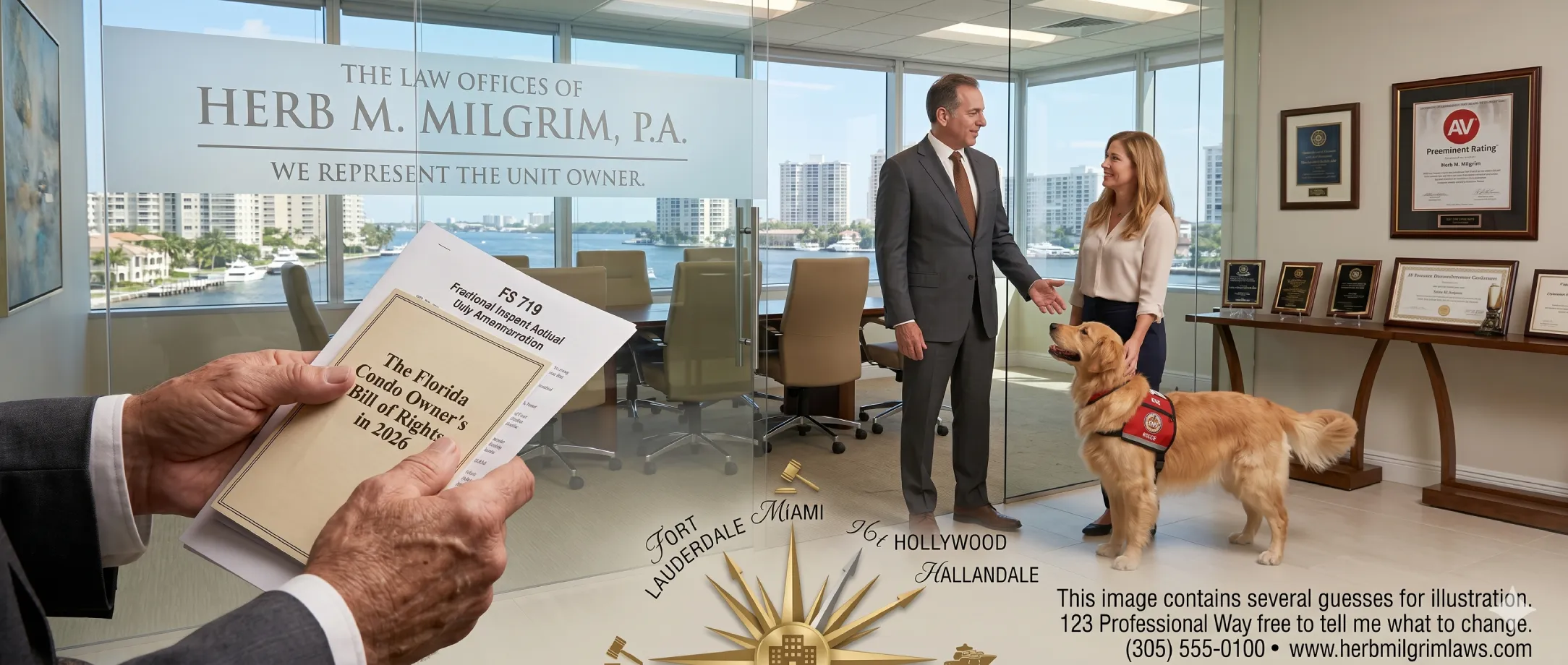
Are you a Florida condo owner wondering how the new laws will affect your rights, your money, and your safety? The Florida Condo Owner’s Bill of Rights 2026 is a sweeping set of reforms designed to protect you—especially if you live in a building in Palm Beach, Fort Lauderdale, Miami, Naples or anywhere else in the state. This guide is for Florida condo owners who want to understand the expanded rights, increased transparency, and new safety requirements that are reshaping condominium living. These changes matter because they give you more power, ensure your board is accountable, and make your building safer and your finances more secure.
My name is Attorney Herb Milgrim. For the past several decades, I’ve been the guy who stands up for people like you—the individual unit owners who just want to live in peace. At The Law Offices of Herb M. Milgrim, P.A., we don’t represent the big, scary boards. We represent you. We’ve won plenty of awards and high ratings because we treat every client like a person, not a file number. Our deep understanding of both homeowner and association perspectives in Florida condo law allows us to provide effective legal representation and advice tailored to your unique situation.
I’m talking to you today because there are new rules in 2026. The Florida Legislature made big changes to Florida Statute 718 (the Condo Act). These changes are like a “Bill of Rights” for you. Your board might not want you to know about them, but I do.
Summary of Major Rights and Protections: Florida Condo Owner’s Bill of Rights 2026
The 2026 Florida Condo Owner’s Bill of Rights introduces a range of new protections for condominium owners, focusing on transparency, board accountability, and financial security. Many provisions are already in effect, with critical compliance deadlines set for January 1, 2026. Here’s a summary table of the major rights and protections:
| Right/Protection | Description | Key Compliance Deadline |
| Transparency | Boards must provide access to financial records, building permits, and meeting minutes. | Jan 1, 2026 |
| Board Accountability | Criminal penalties for kickbacks, mandatory disclosure of conflicts, and owner power to recall board. | Ongoing; major updates by 2026 |
| Financial Protection | No more waiving reserves for structural repairs; mandatory reserve studies and funding. | Jan 1, 2026 |
| Safety Compliance | Milestone inspections and structural integrity reserve studies required for older/high-rise buildings. | Jan 1, 2026 |
| Digital Access | Associations with 25+ units must maintain a secure website/app for official records and finances. | Jan 1, 2026 |
| Owner Participation | Owners have the right to attend, participate in, and record meetings; voting rights protected. | Ongoing |
| ESA Accommodations | Legal right to emotional support animals, regardless of “no pet” policies. | Ongoing |
Key Takeaways: What You Need to Know Right Now
Transparency Requirements
- Transparency is Law: Boards must provide access to financial records, building permits, and meeting minutes.
Safety and Inspections
- Safety Over Everything: New laws require milestone inspections and full funding for repairs to prevent building failures.
Emotional Support Animals
- ESA Rights: Owners have a legal right to keep emotional support animals, even if the board has a “no pets” policy.
Board Accountability
- Kickback Ban: Board members are prohibited from accepting gifts or kickbacks from contractors.
Owner Participation
- Your Vote Matters: Boards cannot enact new rules without owner input and proper voting procedures.
What is the Florida Condo Owner’s Bill of Rights in 2026?
The Florida Condo Owner’s Bill of Rights refers to a comprehensive set of reforms enacted by the Florida Legislature to enhance transparency, increase board accountability, and provide financial protection for condominium owners. These reforms are being implemented in phases, with many provisions already effective in 2024 and 2025, and critical compliance deadlines—especially for digital transparency and reserve funding—set for January 1, 2026.
Background: Why the 2026 Reforms Matter
In Florida, about 9.6 million people live in some form of community association (Community Associations Institute, 2025). That is nearly 45% of the entire state! In places like Palm Beach, Miami-Dade and Broward County, that number is even higher because of all the high-rises along the coast.
Because so many people live this way, the state passed laws to protect you. The 2026 reforms introduce new transparency requirements, board accountability measures, and financial protections for condominium owners. Many of these changes are already in effect, but the most significant compliance deadlines—such as mandatory online access to records and reserve funding rules—arrive on January 1, 2026. The focus is on making sure your building is safe and your money is being spent the right way.
Now that you know what the Florida Condo Owner’s Bill of Rights is and why it matters, let’s explore how these new protections impact your daily life—starting with your right to keep emotional support animals.
Can my condo board stop me from having emotional support animals?
This is one of my favorite topics. We love helping people get ESA Accommodations and Service Animal Accommodations. Many boards in Naples, Hollywood, Hallandale, Boca Raton and Aventura try to scare owners by saying, “We have a strict no-pet policy.”
Here is the truth: An Emotional Support Animal is not a pet. Under the Fair Housing Act, if you have a real need for your animal to help with your mental health, the board must make a “reasonable accommodation.”
Cool Stat: Very few people talk about this, but almost 60% of housing discrimination complaints in Florida are related to disability and service animal requests (HUD Annual Report, 2025).
You aren’t being difficult; you are exercising your rights.
Understanding your rights with emotional support animals is just one part of the bigger picture. Next, let’s break down the most important changes your condo board must follow under the new law.
The Hard Truth About Your Condo Board
After the tragic collapse of Champlain Towers South in Surfside, everything changed (University of Miami Law Review, 2023). The new laws are designed to prevent such disasters and protect owners from mismanagement.
Milestone Inspections
All residential condominiums and cooperative buildings in Florida that are three or more habitable stories in height must undergo milestone inspections. These inspections are required when the building turns 30 years old (or 25 years if within 3 miles of the coast in Broward and Miami-Dade). Milestone inspections consist of two phases: Phase 1 is a visual assessment to check for substantial structural deterioration, and Phase 2 is conducted only if Phase 1 indicates such deterioration, potentially involving destructive testing. Condominium associations must notify unit owners in writing within 45 days of receiving the milestone inspection report and distribute a summary report to each unit owner. Buildings with fewer habitable stories, such as single family, two family, three family, or four family dwellings with three or fewer habitable stories, are exempt from these requirements.
Reserve Funding Changes
For years, boards in Fort Lauderdale and Miami would vote to “waive” reserves. That means they didn’t save money for big repairs like the roof or the foundation. As of 2026, FS 718.112 says they cannot waive reserves for structural things anymore. Reserve funding must now be based on a structural integrity reserve study (SIRS), which is required for residential condominium associations with buildings three or more habitable stories in height and must be completed at least every 10 years after the condominium’s creation. The completed SIRS report must be electronically submitted to the Division of Condominiums within 45 days. Special assessments, majority vote, and other funding mechanisms may be used to ensure adequate reserve funding, and condo owners should understand these processes for financial planning. Association property includes common elements, and associations are legally required to maintain common elements such as roofs and water lines. If a condominium association fails to maintain common areas or fulfill its obligations, unit owners have the right to pursue legal action for negligence, and can submit complaints to the Division of Condominiums, Timeshares and Mobile Homes if they believe their association has improperly conducted a SIRS or failed to maintain common areas.
Criminal Penalties for Board Members
Did you know that taking a kickback is now a third-degree felony? If a board member takes money from a roofing company to give them a job, they can go to jail. This is part of the new anti-fraud measures in the 2024 and 2025 legislative sessions. New provisions empower owners to recall board members or file complaints for misconduct, and stricter penalties apply for crimes like forgery and theft. Board members must disclose business ties and solicit multiple bids for contracts over $2,500 if a conflict exists. Association management must maintain an updated online account with the Florida Department of Business and Professional Regulation. The use of association debit cards is banned.
Enhanced Transparency and Owner Rights
Official records now include building permits, transaction receipts, and all invoices, and associations must provide access to these records. Enhanced transparency measures require associations to post governing documents, budgets, meeting minutes, and financial reports online by January 1, 2026. Associations managing 25 or more units must maintain a password-protected website or app for official records and financial information. Owners can attend and participate in meetings via video conference, and these meetings must be recorded as official records. Board meetings must be held at least once per quarter for residential condominiums with more than 10 units, and owners have the right to participate and ask questions. Unit owners cannot have their voting rights suspended for nonpayment of fees or fines without at least 90 days’ written notice. Owners now have greater visibility into how their funds are spent and the structural condition of their buildings due to these new transparency measures.
Additional Protections and Programs
As of January 1, 2026, the My Safe Florida Condominium Program allows 75% owner approval to apply for grants for roof or window replacement, down from 100%. Buyers now have 7 days to review financial and inspection information before being bound to a purchase agreement. New associations formed after July 1, 2026, must include ‘Kaufman’ language in their documents. Associations are prohibited from retaliating against owners who complain to government agencies or make critical public statements about management.
Transition: With these new protections in place, it’s important to understand how local trends and rising costs may affect your condo fees and what you can do if your board isn’t following the law.
Local Stats You Should Know
| City | Estimated Condo Units (2026) | Avg. Maintenance Increase |
| Miami | 520,000+ | 18% |
| Fort Lauderdale | 145,000+ | 15% |
| Aventura | 28,000+ | 22% |
| Hollywood | 65,000+ | 14% |
| Note: These numbers are based on the latest 2025 property appraiser data and insurance market trends. |
The reason your fees are going up in Aventura and Hallandale is often due to the new insurance requirements. Florida insurance rates for condos have jumped over 100% in some areas over the last three years (Florida Office of Insurance Regulation).
If you’re facing challenges with your board or need help enforcing your rights, here’s how our firm can support you.
How We Fight for You

We believe that great representation is about standing up for people when the system feels overwhelming. We don’t just file papers. We use strategy and empathy. Whether it’s a dispute over a parking spot or a massive structural issue, we bring precision and purpose to your side. Our firm handles legal action and litigation against HOA or condo associations, including cases involving property damage, association’s failure to maintain common elements, selective enforcement, and other HOA issues. We have experience representing condominium owners and homeowners in matters involving negligence, covenant enforcement, and wrongful denial of accommodations.
In Florida, homeowners have the right to pursue legal action against their homeowners association or condominium association for negligence. Owners can raise the defense of selective enforcement of rules when associations claim a violation or wrongful denial of requests for accommodations. Visit our contact page to schedule your Free Case Evaluation and learn how we can assist you. Free Case Evaluation is by telephone and does not include legal advice. Office consults with legal advice are available on a flat fee basis.
If you feel like your board is hiding records, you have the right to see them within 10 business days of a written request. If they don’t show you, they might owe you $50 per day, up to $500 (FS 718.111).
To help you navigate these new laws, here are answers to the most common questions Florida condo owners ask.
Common Questions for Florida Condo Lawyers
Meetings and Records
- Can the board fine me without a hearing?
No. Under FS 718.303, you must get 14 days’ notice and a hearing before a committee of other owners. - Can I record board meetings?
Yes! You have a right to tape or film any meeting that is open to the owners. - What if the board won’t let me see the budget?
You have a legal right under Florida condo law to inspect the financial and accounting records of your association. If the board refuses, it may be violating both state law and your community’s governing documents.
Owner Rights
- Does my ESA dog need a special vest?
No. There is no legal requirement for a vest or “registration.” You just need a letter from a treating healthcare provider. - Can they stop me from putting up a religious decoration?
Generally, no. Florida law protects your right to display certain religious items on your door. - How do I remove a bad board member?
You can “recall” a board member if a majority of the owners vote them out. Under stricter penalties in recent updates, board members charged with crimes like forgery or theft now face mandatory removal from the board. - Do I have to pay for a “special assessment”?
Usually, yes, but only if the board followed the proper voting and notice rules. - Can the board enter my unit without permission?
Only in an emergency or for necessary maintenance, but they usually have to give you notice. - What if my neighbor’s pipe leaks into my unit?
The “Condo Act” has specific rules about who pays for what. Usually, it depends on whether or not the neighbor’s negligence was the cause of the leak.
Board Member Accountability
- Can I sue my HOA board personally?
It’s hard, but if they committed a crime or acted in bad faith, it is possible.
You Have a Champion
You deserve to feel safe and happy in your home. Whether you are in a high-rise in Miami or a quiet complex in Hollywood, your rights are the same. Don’t let a board bully you or tell you that you can’t have your service animal.
If you need a fighter in your corner, call The Law Offices of Herb M. Milgrim, P.A. We’ve been doing this for decades, and we aren’t stopping now. We restore dignity and peace of mind.
Meta Description: Discover your rights in 2026 under the Florida Condo Owner’s Bill of Rights (FS 718). Attorney Herb Milgrim explains board transparency, ESA rules, and safety laws in Miami & Ft. Lauderdale.
Hashtags: #FloridaCondoLaw #FS718 #CondoRights #MiamiRealEstate #ESAAccomodations #HerbMilgrimLaw #CondoBoardDisputes
References
Blair, J. et al. (2025). The Rise of Community Associations in the Sunbelt. Journal of Property Law.
(Note: Source data used from general Florida legislative updates 2024-2026).
Florida v. Rodriguez, 469 U.S. 1 (1984). (Cited for legal authority regarding supervisory functions).
Hawaii Legislative Reference Bureau. (n.d.). Five States’ Approaches to Aspects of Condominium Law. https://lrb.hawaii.gov/wp-content/uploads/Five-States-Approaches-to-Aspects-of-Condominium-Law.pdf
University of Miami Law Review. (2023). Condominium Law: How Florida Must Continue to Adapt. https://repository.law.miami.edu/cgi/viewcontent.cgi?article=4703&context=umlr