
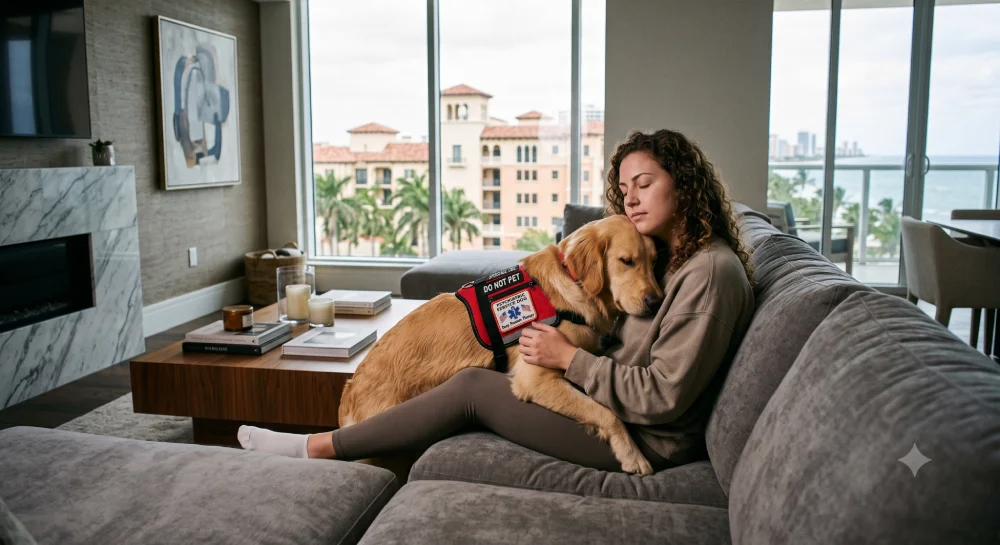
If you are a Florida condominium owner navigating a mental health disability like severe PTSD, panic disorder, or debilitating anxiety, your assistance animal is not a pet. It is a vital medical accommodation.
Yet, across the Sunshine State, condo boards are launching aggressive, highly coordinated crackdowns on residential animals. Terrified owners are receiving boilerplate violation notices, daily $100 fines, and heavy-handed threats of forced animal removal or building eviction.
Why has this hostility suddenly exploded? On May 22, 2026, the U.S. Department of Housing and Urban Development (HUD) issued a historic internal policy reversal, permanently rescinding its previous, lenient administrative enforcement guidelines. Under this new directive, HUD has confined its internal administrative prosecutions exclusively to animals that meet a trained-task standard. This means if a tenant files a bureaucratic complaint with HUD over an untrained Emotional Support Animal (ESA), the federal agency will no longer pursue charges against the condo association.
Condo boards from Miami to Naples have completely misinterpreted this federal shift. Arrogant property managers and association attorneys are falsely telling owners that ESAs are completely dead and that any dog over a standard pet weight cap must be removed. They are flat-out wrong.
While HUD has scaled back its internal administrative investigations, your core substantive housing rights remain fully protected. Crucially, your legal defense relies heavily on a massive, hidden distinction that most condo boards do not understand: the legal line between an untrained Emotional Support Animal and a trained Psychiatric Service Dog (PSD). By understanding how a PSD differs from an ESA under the law, and how Florida Statute § 760.27 strictly protects both at the state level, you can aggressively defeat board overreach in a court of law using your private right of action.
Key Takeaways for Florida Condo Owners
- The Core Legal Right: Under federal fair housing laws and Florida civil rights statutes, both Psychiatric Service Dogs (PSDs) and Emotional Support Animals (ESAs) are legally classified as medical accommodations—not pets—exempting them entirely from association pet rules.
- The Board Limit: Condo boards cannot enforce weight limits, size restrictions, or breed bans against a legitimate PSD or ESA, nor can they use HUD’s 2026 administrative policy shift as an excuse to ignore state-level fair housing laws.
- Immediate Action Step: If your board issues a denial or attempts to fine you, bypass the useless, teeth-stripped federal HUD complaint backlog entirely. Retain Attorney Milgrim to file a private civil action in Florida State Court to secure an immediate emergency injunction.
What Is the Legal Difference Between a Psychiatric Service Dog (PSD) and an Emotional Support Animal (ESA) in Florida Housing Disputes?
The fundamental legal distinction between a Psychiatric Service Dog (PSD) and an Emotional Support Animal (ESA) hinges entirely on individual task training. A Psychiatric Service Dog is a dog individually trained to perform specific, active physical tasks to mitigate a mental health disability—such as pawing its owner to abort a panic attack—whereas an Emotional Support Animal provides therapeutic comfort through its passive presence alone without requiring any specialized training.
This single distinction completely reshapes how your case is litigated in the wake of the 2026 HUD enforcement shift. Because a PSD is classified as a trained service animal under the Americans with Disabilities Act (ADA) standard, its legal status is presumptively reasonable and carries an incredibly low burden of proof.
If your dog is a PSD, a condo board is strictly prohibited from interrogating you or demanding clinical medical files. Conversely, while an ESA remains a fully protected accommodation under Florida state law, it is subjected to a higher level of board scrutiny regarding medical documentation, making it the primary target for rogue associations trying to exploit HUD’s administrative retreat.
The Disability Accommodation Spectrum
| Characteristic | Psychiatric Service Dog (PSD) | Emotional Support Animal (ESA) |
| Training Requirement | Requires individual task-training | Requires zero special training |
| Type of Support | Performs active medical work (e.g., deep pressure therapy) | Provides passive therapeutic comfort via presence alone |
| HUD Administrative Status | Presumptively protected by HUD | Subject to HUD administrative retreat |
| Board Scrutiny Level | Near-zero board interrogation permitted | Protected by Florida law, but subject to higher documentation scrutiny |
| Housing Remedy | Both are fully exempt from association covenants, weight caps, and pet fees | Both are fully exempt from association covenants, weight caps, and pet fees |
The 2026 Battleground: HUD’s Administrative Retreat vs. Florida’s Ironclad Shield
To shut down an overreaching property manager or board president, you must understand the exact legal boundaries of the current housing market. Condo defense firms are flooding complexes with scary, misleading circulars regarding the recent HUD memo. Here is the actual reality.
1. The Reality of the May 22, 2026 HUD Memorandum
HUD’s Office of Fair Housing and Equal Opportunity (FHEO) issued an internal enforcement memorandum stating that, effective immediately, for the purposes of HUD’s own internal agency investigations, they will only find reasonable cause and recommend prosecution for animal accommodation complaints that meet a trained-task standard. Essentially, HUD adjusted its internal administrative resources to mimic the strict ADA service animal definition.
However, HUD’s internal memo did not amend the text of the federal Fair Housing Act, nor did it wipe out federal case law. The federal statute still dictates that accommodations must be made for assistance animals. Most importantly, HUD explicitly noted in their memorandum that individuals retain an absolute right to bypass the slow administrative agency and file a private civil lawsuit in federal or state court.
2. The Power of Florida Statute § 760.27
While the federal administrative framework stepped back from untrained animals, the State of Florida maintains an independent, ironclad shield. Under Florida Statute § 760.27, the state explicitly codifies protections for untrained emotional support animals. Florida law defines an ESA as an animal that “does not require training to do work” but whose presence “alleviates one or more identified symptoms or effects of a person’s disability.”
Because your condominium sits on Florida soil, your board must comply with Florida civil rights laws regardless of HUD’s internal administrative shifts. If a board uses the HUD memo to reject a legally compliant ESA request, they are actively committing an illegal act of housing discrimination under Florida law.
How to Weaponize the PSD vs. ESA Distinction to Win Your Case
If your dog performs active tasks, treating them merely as an ESA is a massive legal mistake that plays right into the board’s hands. Categorizing your dog correctly changes the rules of engagement in court.
The Inviolable Status of a Psychiatric Service Dog (PSD)
If you have a PSD, your dog stands on the highest tier of legal protection. Under both the ADA framework and the Fair Housing Act, a housing provider’s ability to question a service animal is extremely limited. If your disability is not obvious, the board is legally permitted to ask only two specific questions:
- Is the animal required because of a disability?
- What work or task has the animal been trained to perform?
The board cannot demand to see a live demonstration of the task. They cannot demand a professional training certificate, as self-training is fully recognized under the law. Most importantly, they cannot demand a medical letter or examine your psychiatric history. If your dog alerts you to oncoming panic attacks, positions its body to create physical space in crowds, or provides deep pressure therapy to interrupt a PTSD episode, it is a PSD, and the board must back off immediately once those two questions are answered.
Navigating the ESA Paper Trail Safely
If your animal provides passive comfort and is classified as an ESA, Florida law does allow the board to request “reliable information” supporting the accommodation if your disability is not readily apparent. However, the association’s inquiries are heavily restricted under Florida Statute § 760.27(3)(a):
- They cannot demand your complete private medical records.
- They cannot require you to disclose your specific clinical diagnosis or the severity of your mental health condition.
- They cannot force you or your doctor to fill out an invasive, custom medical form or provide a notarized statement.
The Procedural Roadmap: Defeating a Board’s Removal Threat
If an aggressive board issues a violation notice or denies your animal, you must establish an unassailable legal paper trail before marching into court.
1.Determine the Correct Animal Classification:Prerequisite.
Evaluate your dog’s daily behavior. If the dog is individually trained to perform an active task that interrupts or mitigates your psychiatric symptoms, classify the dog as a Psychiatric Service Dog (PSD). If the dog provides passive comfort without a trained task, classify it as an Emotional Support Animal (ESA).
2.Submit a Formal Written Request via Certified Mail:Establishing Notice.
Deliver a formal written request for a reasonable accommodation to the board. For an ESA, attach a legally compliant letter from your treating healthcare professional licensed in Florida. For a PSD, clearly state the answers to the two permissible statutory questions regarding disability status and task training.
3.Document the Board’s Illegal Demand or Denial:The Statutory Breach.
Keep a meticulous log of the board’s response. If the board demands complete medical charts, insists on a custom form, or issues an outright denial citing the 2026 HUD memorandum, they have formally committed a discriminatory housing practice.
4.File a Civil Lawsuit and Request an Emergency Injunction:Courthouse Enforcement.
Have your litigation counsel file a formal civil complaint in the local Florida circuit court invoking your Private Right of Action. Simultaneously, file for an Emergency Temporary Injunction to instantly freeze all fines, legal threats, and removal actions while a judge decides the case.
Turning the Financial Tables: Forcing the Board to Pay Your Lawyer
The absolute primary reason condo boards bully disabled owners is economic. They assume an individual resident cannot afford to match the massive legal war chest funded by the building’s collective association dues.
Florida housing laws completely flip this financial dynamic through statutory fee-shifting provisions. Under Florida Statute § 718.303, the prevailing party in an enforcement dispute between an owner and a condominium association is legally entitled to recover all reasonable attorney’s fees and court costs from the losing party.
At The Law Offices of Herb M. Milgrim, P.A., our entire practice is built around this exact consumer-protection mechanism. We exclusively represent individual Condo Owners and Homeowners—we NEVER represent HOAs or Condo Boards.
When we step into a dispute and demonstrate to the association’s corporate counsel that their board is operating on a legally flawed interpretation of HUD guidelines, their aggressive posture routinely implodes. They realize that if they lose a civil fair housing case in state court, a Florida judge will force their board to write a massive, six-figure check to cover your entire legal bill, which would require a painful, building-wide special assessment on all your neighbors.
Local Enforcement Realities Across Florida Counties
The operational hostility of condominium associations varies heavily depending on the geographic concentration of high-density housing markets across the state:
- Miami-Dade County & Broward County: High-rise communities in Sunny Isles, Aventura, Miami, Fort Lauderdale, Hollywood, and Hallandale are notorious for using strict weight limits (e.g., “no dogs over 20 pounds”) to keep larger dogs out of common elevators. Properly classifying a larger dog as a PSD completely neutralizes these weight boundaries instantly.
- Palm Beach County & Boca Raton: Associations in master-planned communities across Boca Raton and West Palm Beach heavily rely on corporate real estate defense firms. These firms often attempt to trap owners by sending lengthy, illegal medical questionnaires. Filing an immediate state court action cuts right through their paper delays.
- Collier County & Pinellas County: In retirement havens like Naples and Sarasota, aging condo boards frequently try to enforce sweeping “no-pet” historical covenants against assistance animals. Standing firmly on Florida Statute § 760.27 and the private right of action is the only way to safeguard your home.
Frequently Asked Questions
1. Can a condo board demand to see a professional training certificate for a Psychiatric Service Dog?
No. Under federal and state guidelines, a service dog can be completely self-trained by the handler. An association cannot demand a professional training certificate, formal registration, or a live demonstration of the trained task.
2. Can a condo board use HUD’s May 22, 2026 memo to reject my untrained ESA?
Absolutely not. The HUD memo only impacts the federal agency’s internal administrative choices for pursuing cases. It did not alter the text of the Fair Housing Act, and it has zero authority over Florida Statute § 760.27, which explicitly protects untrained ESAs at the state level.
3. What questions is a condo board allowed to ask if I claim my dog is a PSD?
If your disability is not readily apparent, the board can only ask two questions: (1) Is the dog an assistance animal required because of a disability? and (2) What work or task has the dog been trained to perform? Any questions beyond these are illegal.
4. Can an association enforce a breed ban or weight limit against a legitimate PSD or ESA?
No. Assistance animals are not pets. Therefore, standard condominium rules regarding weight caps, height limits, size restrictions, or specific breed bans are entirely inapplicable to a legally documented service dog or ESA.
5. Can a condo board charge me an application fee or a pet deposit for my ESA or PSD?
No. Housing providers are strictly prohibited from charging any additional fees, pet premiums, administrative processing costs, or security deposits as a condition for honoring an assistance animal accommodation.
6. What kind of doctor’s letter is required to protect an ESA under Florida law?
You need a formal letter on official letterhead from a licensed healthcare practitioner or telehealth provider who has personal knowledge of your disability. The letter must state that you have an impairment that substantially limits a major life activity and that the animal provides therapeutic support.
7. Is an online ESA registration card bought off the internet enough to win a court case?
No. Florida Statute § 760.27(3)(c) explicitly states that an online registration, identification card, certificate, or patch bought from an internet registry is not, by itself, sufficient to reliably establish a disability or a disability-related need for an animal.
8. What happens if the board attempts to fine me $100 a day while my ESA request is pending?
Your attorney can immediately file for a temporary injunction in state court. A Florida circuit judge can order the association to instantly freeze all fining mechanisms, penalties, and enforcement actions while the underlying legal merits of your request are evaluated.
9. Can the association force me to use their own proprietary medical verification forms?
No. Under Florida law, a condo association cannot require the use of a specific form or notarized statement, nor can they deny your accommodation request simply because you chose to submit your practitioner’s information via a traditional letter instead of their packet.
10. If I sue my condominium association for an animal denial, who pays for my legal team?
Under Florida’s mandatory fee-shifting statutes, if you prevail in a lawsuit against your association for violating the Condominium Act or state fair housing laws, the court can order the losing condo board to pay 100% of your reasonable attorney’s fees and court costs.
Stand Up to Board Discrimination
Do not let an arrogant board president or an aggressive property manager weaponize a federal administrative memo to separate you from your assistance animal. Whether your dog is an individually trained Psychiatric Service Dog or a legally documented Emotional Support Animal, your right to equal housing enjoyment is protected under Florida law.
If your association is issuing violation letters, threatening legal action, or demanding private medical records, contact The Law Offices of Herb M. Milgrim, P.A. today to protect your rights. We will evaluate your documentation, clarify your dog’s correct legal status, and execute the aggressive state court strategies necessary to safeguard your home and force the board to comply with the law.