
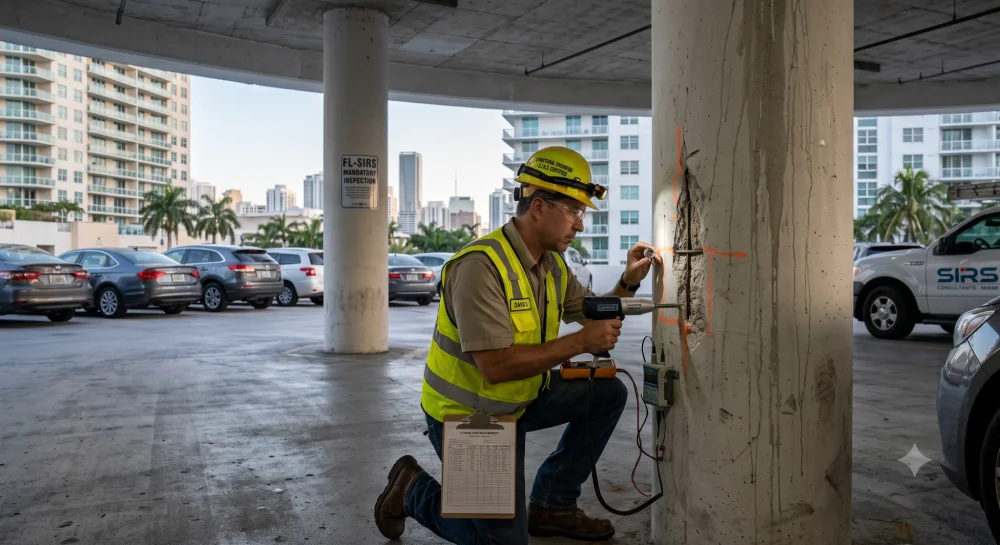
If you live in a Florida condominium three stories or higher, you are likely watching your board panic over the wrong things. Many rogue boards across the state are currently burning through association funds staging aggressive, legally flawed crackdowns—such as misinterpreting the recent May 22, 2026 HUD Policy Reversal to unlawfully deny untrained Emotional Support Animals (ESAs) despite the ironclad protections of Florida Statute § 760.27—while completely ignoring a massive, ticking legal timebomb: the mandatory Structural Integrity Reserve Study (SIRS).
The initial statutory deadline for existing owner-controlled buildings to complete their first SIRS was December 31, 2025. Now that we are well into 2026, the grace period is over, and many associations have flat-out failed to comply.
Criterium-Cromer Engineers+ 1
Condo boards routinely try to sweep this failure under the rug, making excuses about engineering backlogs, insurance delays, or financial constraints. They assume that skipping or stalling on this study is a harmless paperwork oversight that only impacts the building’s internal accounting. They are dead wrong.
Failing to complete a SIRS is a severe statutory violation that jeopardizes your building’s safety, destroys your property values, and exposes individual board members to severe personal liability. As a condo owner, you do not have to sit back and watch your board run the building into financial and structural ruin. You have the immediate right to take legal action.
Key Takeaways for Florida Condo Owners
- The Core Legal Right: Under Florida law, unit owners have an absolute statutory right to live in a structurally sound building backed by a fully compliant, professionally executed Structural Integrity Reserve Study.
- The Board Deadline Limit: Condo boards cannot waive, underfund, or delay mandatory SIRS reserve funding for structural components; the initial deadline expired on December 31, 2025, and the narrow extension to December 31, 2026 applies only if strictly paired with an active milestone inspection.
Florida HOA compliance, on autopilot - The Immediate Action Step: If your board has failed to complete its SIRS or is adopting a budget that refuses to fund structural reserves, bypass the state’s slow administrative channels and retain a dedicated homeowner-rights litigation attorney to file a civil lawsuit in state court.
What Happens If a Florida Condo Board Fails to Complete a Mandatory Structural Integrity Reserve Study (SIRS)?
If a Florida condominium board fails to timely complete a mandatory Structural Integrity Reserve Study (SIRS), it constitutes an explicit breach of the officers’ and directors’ fiduciary duty to the unit owners under state law. This statutory failure strips the association of its legal protections, exposes individual board members to personal liability for willful neglect, and automatically disqualifies the entire condominium building from securing or renewing property insurance through Citizens Property Insurance Corporation.
Perez Mayoral, P.A.
For decades, boards could rely on a majority vote of the unit owners to waive or reduce reserve funding, kicking the maintenance can down the road indefinitely. The post-Surfside legislative reforms permanently ended that practice. Under the current 2026 legal framework, the math that drives structural safety is mandatory, and failing to execute that math triggers immediate legal and financial chaos.
OnLine Training Institute
When a board skips the SIRS, they aren’t just violating a bureaucratic rule; they are actively committing a breach of trust. Florida courts treat a board’s failure to obtain a required SIRS as a knowing and willful violation of their fiduciary relationship to the unit owners under Florida Statute § 718.112. This statutory trigger allows owners to bypass typical corporate shields and hold stalling boards directly accountable in a court of law.
Perez Mayoral, P.A.
The Consequences of a SIRS Compliance Failure
| Category | Impact / Breach Type | Direct Legal & Financial Consequences |
| Statutory Breach | Fiduciary Duty Violation | Constitutes an automatic breach of the board’s fiduciary duty to unit owners under Florida law. |
| Insurance Denial | Loss of Coverage Eligibility | Causes immediate loss of Citizens Property Insurance Corporation eligibility statewide. |
| Civil Lawsuit | Court Action by Unit Owners | Enables unit owners to invoke their Private Right of Action in Florida State Court. |
| Contextual Remedy | Court-Ordered Relief & Penalties | Court orders mandatory compliance and shifts 100% of attorney’s fees to the association. |
The 2026 Legal Landscape: Deadlines, Thresholds, and Board Fallacies
To protect your investment, you must understand the exact rules your board is likely trying to distort. Many association attorneys are currently sending out confusing memos trying to conflate different deadlines to hide their non-compliance. Here is the actual state of the law.
1. The Strict 2025/2026 Timelines
For existing owner-controlled associations with buildings reaching three or more habitable stories, the absolute deadline to complete the initial SIRS was December 31, 2025.
Construction Solutions, Inc. (CSI)
There is only one narrow exception under current law: if your building is also required to undergo a physical Milestone Inspection under Section 553.899 on or before December 31, 2026, the board may coordinate the two studies and deliver the SIRS concurrently. However, under no circumstances can the SIRS be extended past December 31, 2026. If your building is not explicitly due for a 2026 Milestone Inspection, your board is already in active violation of Florida law.
Construction Solutions, Inc. (CSI)
2. The Inflation-Adjusted Reserve Thresholds
The financial scope of what a board must track has also shifted. For 2026, the statutory threshold for mandatory reserve items has been adjusted for inflation to $25,675. Any deferred maintenance expense or replacement cost exceeding this amount for critical structural components—including the roof, primary structure, load-bearing systems, fireproofing, plumbing, electrical systems, waterproofing, windows, and exterior doors—must be fully funded. Owners can no longer vote to waive or reduce these structural reserves.
Florida Engineering LLC+ 1
The Step-by-Step Guide for Owners Facing a Non-Compliant Board
If your board is dragging its feet, you cannot afford to wait for a structural failure or an insurance cancellation notice to arrive. You must take a proactive approach to document their failure and prepare your legal case.
1
Demand Written Proof of SIRS Completion
Verify Status
1.Demand Written Proof of SIRS Completion:Verify Status.
Submit a formal, written certified letter to the board demanding access to the association’s official records, specifically requesting a copy of the completed Structural Integrity Reserve Study and the signed board affidavit acknowledging its receipt. Under Florida law, the board must make these records available within 10 business days.
2
Inspect the Annual Budget for Compliance
Analyze Budget
2.Inspect the Annual Budget for Compliance:Analyze Budget.
Review the association’s current operating budget. Check if the structural components identified by the state are fully funded based on a professional reserve schedule. If the board is still pooling structural funds with general operating cash or attempting to waive these reserves, they are violating the explicit mandates of F.S. § 718.112.
3
Verify DBPR Electronic Reporting Status
Check Portal
3.Verify DBPR Electronic Reporting Status:Check Portal.
Florida law commands associations to electronically report their SIRS completion status to the Department of Business and Professional Regulation (DBPR) within 45 days of receiving the study. Check the state database to see if your building is listed as non-compliant.
4
File a Civil Action for Fiduciary Breach
File Suit
4.File a Civil Action for Fiduciary Breach:File Suit.
If the board confirms they have not completed the study, ignores your demand, or fails to properly fund the structural line items, retain counsel to file a civil lawsuit in the local circuit court to force compliance via a mandatory injunction.
Shifting the Costs: The Power of Fee-Shifting in Owner Lawsuits
Board members frequently use the association’s collective bank account as a war chest, betting that an individual unit owner will run out of money trying to fund a private lawsuit. Florida’s Condominium Act completely neutralizes this unfair financial advantage.
Under Florida Statute § 718.303, any dispute brought by a unit owner against an association for non-compliance with the Condominium Act triggers a mandatory prevailing party attorney’s fees provision.
If you take your board to court because they failed to complete a mandatory SIRS or refused to fund structural reserves, and you win the case, the judge is legally required to order the association to pay every single dollar of your reasonable attorney’s fees and court costs.
At The Law Offices of Herb M. Milgrim, P.A., our entire practice is built around defending individual consumers from corporate overreach. We exclusively represent individual Condo Owners and Homeowners—we NEVER represent HOAs or Condo Boards. We know how to use this statutory fee-shifting leverage to force reckless boards into compliance without letting them drain your personal life savings.
Local Enforcement Realities Across Florida Counties
The operational and financial fallout of skipping a mandatory SIRS varies depending on where your building sits along Florida’s coastline:
| County | Local Risk Dynamic | Primary Insurance Exposure |
| Miami-Dade County (Miami, Sunny Isles, Aventura) | Extreme high-rise density; local inspectors are actively auditing structural records post-Surfside. | Swift, automatic placement into the high-risk non-compliant pool, triggering immediate policy non-renewals. |
| Broward County (Fort Lauderdale, Hollywood, Hallandale, Pompano) | Aging coastal infrastructure highly vulnerable to structural concrete spalling from severe saltwater exposure. | Immediate threat of premium skyrocketing or outright cancellation by primary domestic carriers. |
| Palm Beach County (Palm Beach, Boca Raton) | Wealthier associations rely on institutional law firms to draft complex delaying letters to owners. | Rejection from standard commercial property markets, leaving Citizens as the only, highly restricted option. |
| Collier & Pinellas Counties (Naples, Sarasota) | Slower local municipal enforcement pipelines, giving rogue boards a false sense of security. | Severe exposure to sudden, massive special assessments once a latent structural defect is finally uncovered. |
Frequently Asked Questions
1. Can the unit owners vote to waive the mandatory SIRS requirement?
No. Florida law explicitly prohibits unit owners from voting to waive or reduce the completion of a Structural Integrity Reserve Study or the funding of reserves for the structural components identified under F.S. § 718.112.
Criterium-Cromer Engineers
2. What is the difference between a Milestone Inspection and a SIRS?
A Milestone Inspection is a purely physical engineering assessment of a building’s structural safety based on its age (typically required at 30 years). A SIRS is a financial and visual study focused on ensuring the association is actively saving the exact amount of money needed to repair those critical structural components over time.
PropFusion+ 1
3. What happens to our property insurance if the board skips the SIRS?
Your building will likely become uninsurable. Citizens Property Insurance Corporation and major private carriers across Florida are currently refusing to write or renew commercial property policies for condominium buildings that fail to provide proof of a compliant SIRS.
4. Can individual board members be held personally liable for failing to complete a SIRS?
Yes. Because Florida law explicitly categorizes the failure to complete a required SIRS as a breach of an officer’s or director’s fiduciary duty, the standard corporate liability shields can be pierced, exposing individual board members to personal liability for willful neglect.
Criterium-Cromer Engineers
5. My board says there is an engineering shortage and they can’t find a provider. Is that a valid legal defense?
No. While there are documented wait times across Florida for qualified engineers and reserve specialists, a provider shortage does not excuse statutory non-compliance. The board must enter into a formal contract and seek local municipal variances if applicable, but simply doing nothing is a breach of duty.
6. Who is legally qualified to perform a SIRS in Florida?
A SIRS must be performed or verified by a Florida-licensed professional engineer, a Florida-licensed architect, or a credentialed professional holding a nationally recognized Reserve Specialist (RS) or Professional Reserve Analyst (PRA) designation.
PropFusion
7. Can the board pass a massive special assessment without owner approval to fund SIRS reserves?
Yes. Current Florida statutes grant condominium boards expanded emergency authority to levy special assessments or secure commercial lines of credit to fund mandatory structural repairs and reserves without requiring a vote of the general membership, overriding any restrictions in the association’s original bylaws.
Wood Smith Henning & Berman LLP
8. What should a prospective buyer look for regarding SIRS before purchasing a condo unit?
Under Florida law, a prospective buyer has an absolute right to inspect the association’s most recent SIRS. If the association has failed to complete the study, the seller must provide the buyer with a formal written statement explicitly disclosing that the association is non-compliant.
Capital Reserve Advisors
9. How often does a Florida condo association have to update its SIRS?
An association must completely refresh and update its Structural Integrity Reserve Study at least once every 10 years throughout the entire lifespan of the condominium building.
Florida Condo & HOA Law Blog
10. Can our board pool SIRS reserve funds with general operating funds to pay for landscaping or painting?
Absolutely not. For all budgets adopted, SIRS reserve funds must be tracked separately and used exclusively for the specific structural components they were designated to protect. Commingling or misappropriating these structural safety funds is strictly illegal.
Hold Your Board Accountable Before Your Property Values Plummet
Do not let an incompetent or stubborn condo board put your financial future and physical safety at risk. If your association in Miami, Fort Lauderdale, Boca Raton, or Naples has missed its mandatory SIRS deadlines, or is actively hiding its compliance status from the owners, you need aggressive, expert representation to protect your rights.
Contact The Law Offices of Herb M. Milgrim, P.A. today to schedule a comprehensive consumer-rights consultation. We will audit your association’s records, break through their delaying tactics, and take the definitive state court action necessary to force compliance and protect your investment.