
Florida Condo Board Negligence: Protecting Your Rights as a Florida Condo Owner
If you’re worried about Florida condo board negligence, you’re not alone. This article is designed specifically for Florida condo owners who want to protect their property and legal rights. Here, you’ll learn how to document negligence by your condo association, what records to request, and how to safeguard your interests if your board fails to maintain your building. We’ll cover the legal duties of condo boards, the steps you should take if you suspect mismanagement, and the importance of keeping a thorough paper trail. Whether you live in Miami, Fort Lauderdale, or anywhere in Florida, understanding these strategies can help you hold your association accountable and ensure your home remains safe and well-maintained.
Key Takeaways: How to Win Against Your Condo Board
- The Power of Paper: Your biggest weapon isn’t a loud voice; it’s a folder full of written evidence.
- The 10-Day Rule: Florida law says your board must let you see records within 10 working days of a written request, or they might owe you money.
- Safety First: In 2026, buildings must have Milestone Inspections to stay safe—make sure your board has a copy of the report.
- Support Animals are Protected: About 60% of all housing complaints in Florida are about disability and support animal rights.
- Local Expertise Matters: We have decades of experience fighting for unit owners in Miami, Fort Lauderdale, and beyond.
Legal Responsibilities of Florida Condo Boards
In Florida, condominium associations are legally responsible for maintaining common elements such as roofs, walls, and plumbing. Board members have a fiduciary duty to act in good faith and manage funds properly. Residents have the right to inspect association records to find evidence of mismanagement. Negligence in a condo association context generally occurs when the association fails to maintain common areas, resulting in harm or damage to residents or guests. Negligence is established by proving the association had a duty, breached that duty, and caused damages.
What Is Negligence and What Are Common Elements?
Negligence in a condo association context generally occurs when the association fails to maintain common areas, resulting in harm or damage to residents or guests. Negligence is established by proving the association had a duty, breached that duty, and caused damages. Common elements typically include shared property such as roofs, walls, plumbing, hallways, pools, and other areas maintained by the association.
How can I document condo association negligence in Florida?
Hi, I’m Attorney Herb Milgrim. For the past several decades, I’ve been the guy who stands up for people living in condos in places like Naples, Boca Raton, Palm Beach, Fort Lauderdale, Miami, Hollywood, Hallandale, and Aventura. My firm, The Law Offices of Herb M. Milgrim, P.A., was built on a simple idea: every person deserves a champion in their corner.
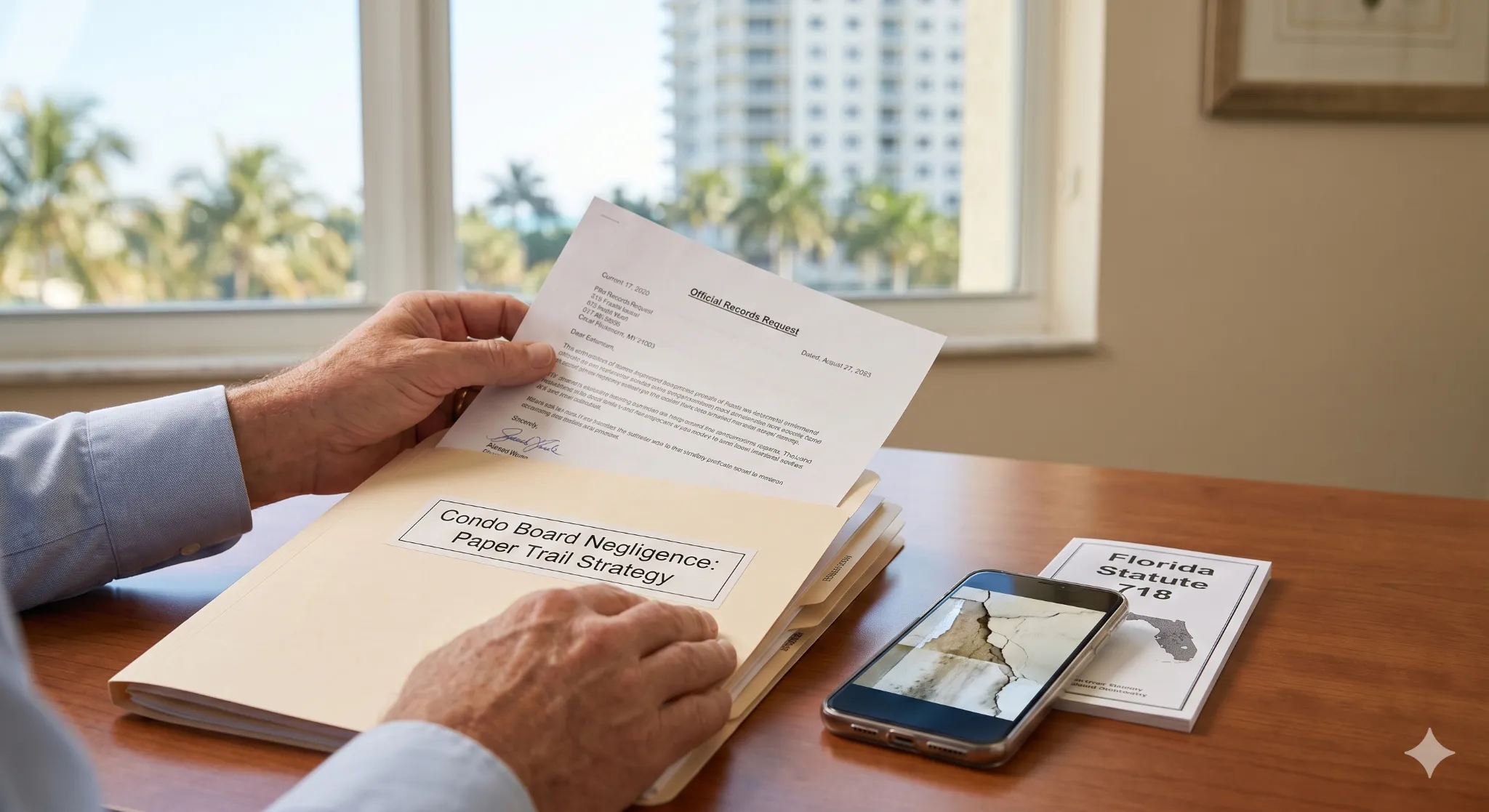
When you live in a condo, your board is in charge of fixing the roof, the pool, and the hallways. But sometimes, they get lazy or try to hide things. If you think they are being negligent, you need a “Paper Trail.” This is a way of keeping track of everything they do wrong before you even call a lawyer.
Negligence in condo associations generally occurs when the association fails to maintain common areas, resulting in harm or damage to residents or guests. Maintenance responsibilities for common areas rest with the board, and the association cannot blame management companies or contractors for failure to maintain these areas. Negligence is established by proving the association had a duty, breached that duty, and caused damages.
The Hidden Stats of Condo Life
Did you know that in 2026, many older coastal buildings are under huge pressure? Some people are even paying monthly HOA fees as high as $1,900 just to avoid the problems of older buildings. With decades of experience, our attorney understands the unique challenges of condo living, where community harmony and effective dispute resolution are essential for residents. When you pay that much, you deserve to have a board that follows the rules. Compliance with financial and legal requirements is crucial to protect your investment and ensure proper management. But here’s a stat most people don’t know: In Broward County, even though home sales are up nearly 8%, many condo buildings are struggling because only 0.9% of them are approved for FHA loans. This is often because the board didn’t save enough money for repairs. When it comes to special assessments or board rules, always review your association’s bylaws to assess the legality of these actions and resolve common area conflicts.
Next, let’s look at the specific records you should request to build your case.
What records should I ask for to prove my condo board is negligent?
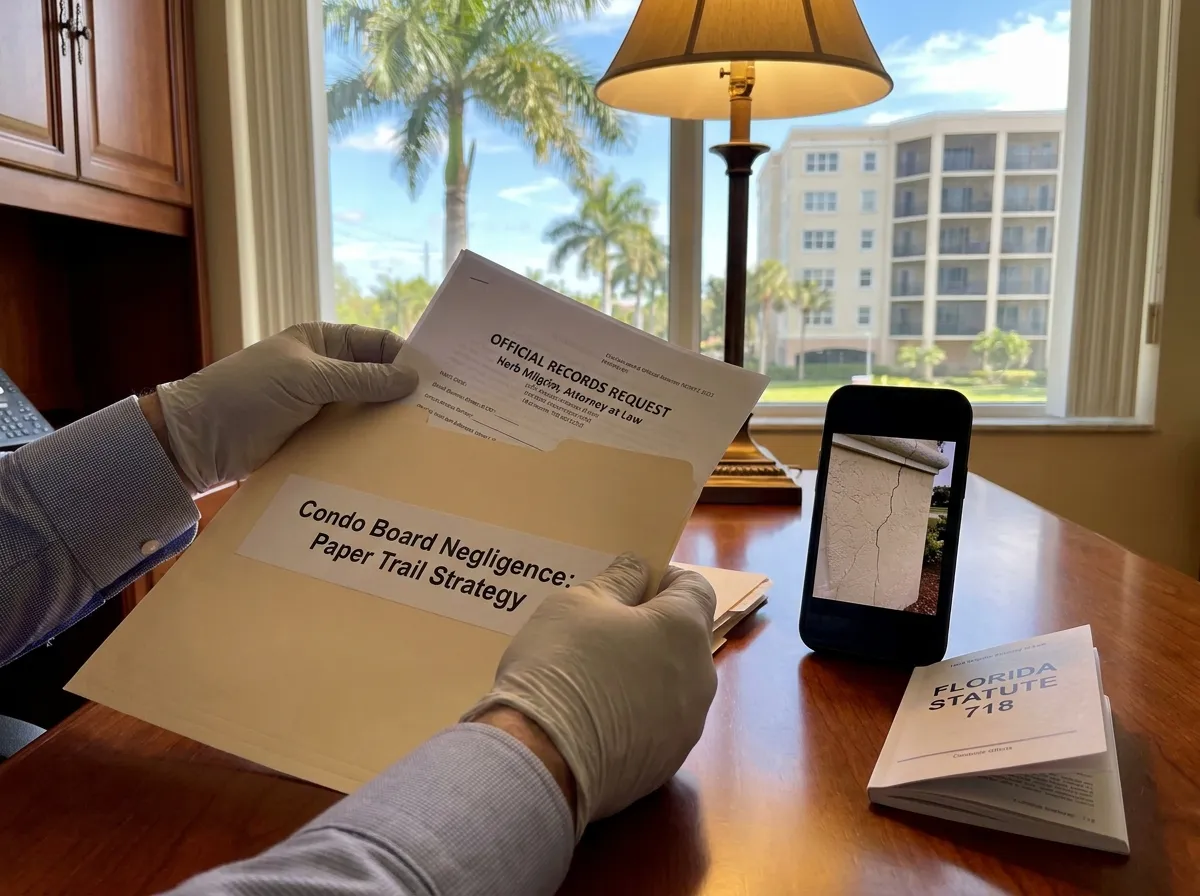
If you think your building is falling apart or the money is missing, you have to look at the Official Records. Under Florida Statute 718.111, the board must keep records for at least 7 years.
Understanding Official Records
Important records to request include:
- Meeting minutes
- Financial statements
- Maintenance logs
- Vendor contracts
- Governing documents
- Insurance coverage
Insurance coverage is especially relevant for property damage claims, as it can determine whether damages to your unit are covered, particularly if the damage originates from common elements.
Under Florida law, residents have the right to inspect association records, including maintenance logs and contracts, to find evidence of mismanagement.
Making a Written Request
Step 1: The Written Request
- Don’t just ask the manager at the front desk. You must send a written letter, which serves as formal written notice to the association.
- Once they get it, they have 10 working days to let you see the books.
- If they don’t, the law says they might have to pay you damages.
- If the association has been notified of a maintenance issue through written notice and fails to address it, unit owners may have legal recourse if property damage results.
Important Records to Request:
- The Milestone Inspection Report: Every building 3 stories or higher must have a structural inspection when it hits 30 years old. If they don’t have this, they are breaking the law.
- Financial Reserves: Florida is the only state where you must put down 25% for a loan if the condo doesn’t have enough reserves. Check if your board is actually saving money for the roof and foundation.
- Maintenance Logs: These show if they are actually fixing things like leaking pipes or broken elevators.
Documenting Physical Evidence
Step 2: Take Pictures and Video
- If there is a hole in the ceiling, signs of water intrusion, or mold in the hallway or within your condo unit, take a picture of it every single day.
- Use your phone to show the date and time.
- Be sure to document whether the damage is originating from your condo unit itself or from common elements maintained by the association.
- This is part of your strategy to show “dignity, stability, and peace of mind” are being taken away from you.
If the condominium association neglects its maintenance responsibilities—such as failing to repair common elements like roofs, walls, or plumbing—it may be held liable for damages caused to individual units due to that negligence.
Structural Integrity Reserve Studies (SIRS)
When it comes to protecting your investment and your safety, few things are as important as the structural integrity reserve studies (SIRS) required by Florida law. Many condo owners don’t realize that these studies are more than just paperwork—they’re a powerful tool for holding your condominium association accountable and making sure your building’s common elements are properly maintained.
Under the Florida Statutes, every condominium association managing a building with three or more habitable stories must complete a structural integrity reserve study at least every 10 years. This isn’t just a box to check: the SIRS must be performed or verified by a licensed engineer, architect, certified reserve specialist, or professional reserve analyst. The goal? To catch potential structural issues early and create a detailed financial plan for repairs and replacements—before small problems become big, expensive ones.
The SIRS report breaks down the life expectancy of each major common element, evaluates the current reserve fund, and recommends a funding method to keep your condominium property safe and sound. Within 45 days of finishing the study, your association is required to distribute a summary of the findings to every unit owner and post the full report on the association’s website, if one exists. They must also submit the SIRS to the Division of Condominiums, Timeshares, and Mobile Homes using the state’s online system.
If you suspect your association’s SIRS is incomplete, includes unnecessary maintenance, or was conducted by someone unqualified, you have the right to file a complaint with the Division or the Department of Business and Professional Regulation (DBPR). Remember, the SIRS directly affects your fee assessments—if the study finds your reserves are too low, the association may need to raise fees or seek loans to meet the required funding schedule.
Disputes over SIRS, reserve funding, or the handling of common elements can get complicated fast. That’s when it’s crucial to have experienced attorneys on your side—professionals who understand the unique challenges of Florida condominium law and can work diligently to protect your property rights. A legal team with extensive experience in condominium and homeowners association law can help you address concerns, represent you in disputes, and ensure your association follows the law.
If you have questions about structural integrity reserve studies, fee assessments, or your association’s responsibilities, don’t wait. Contact a reputable condominium and homeowners association law practice for guidance. With the right support, you can make sure your condo association is doing its job—and keep your home safe for years to come.
Now that you know what records to request and how to document evidence, let’s discuss your rights regarding service animals and emotional support animals in Florida condos.
Fighting for Your Service Animal and ESA Rights
We love cases about Emotional Support Animals (ESA) and Service Animals. Sadly, boards in Hollywood and Aventura often try to bully people with disabilities. But remember, about 60% of all fair housing complaints are about people being denied their support animals. Your board cannot charge you a “pet fee” or a “pet deposit” for an assistance animal.
If you have other questions about your rights as a condo owner, the next section covers the most common legal questions and answers for Florida condo owners.
10 Common Questions for Florida Condo Lawyers
1. Can the board stop me from seeing the budget?
No, you have a right to see the financial records within 10 days of asking. Condominium associations and homeowners associations are responsible for providing access to these records, which include budgets for maintaining common areas and common elements.
2. What is a Milestone Inspection?
It’s a safety check for buildings 3 stories or higher to make sure they aren’t going to collapse. Florida law requires condominium associations to conduct milestone inspections of buildings three or more stories high as part of their duty to maintain common elements and ensure the safety and structural integrity of condominium units and common areas.
3. Do I have to pay for a “special assessment”?
Yes, if the board followed the rules, but you should check if they did a proper inspection first. A majority vote of the total voting interest is required to waive or reduce Structural Integrity Reserve Study (SIRS) reserves when budgets are adopted. Review the insurance requirements and compliance with governing documents of your condominium or homeowners association to ensure the assessment is valid.
4. Can I have an ESA in a “No Pets” building?
Yes, Florida law says the board must make a “reasonable accommodation” for you. Condominium associations must comply with fair housing laws on behalf of residents.
5. What happens if the board ignores my repair request?
That is where your “Paper Trail” comes in—you can show they knew about the problem and did nothing. The Declaration of Condominium acts as a contract, and residents can pursue claims or even sue the association for failing to perform required maintenance. Condominium associations are responsible for maintaining common elements, such as roofs, walls, and plumbing, and may be held liable for damages resulting from their failure to maintain these areas.
6. Are board members protected from lawsuits?
They have “fiduciary risk,” meaning they can be in trouble if they don’t do their jobs right. Board members have a fiduciary relationship with owners, and a breach occurs if the board acts in bad faith, mismanages funds, or ignores known safety hazards. However, the Business Judgment Rule generally protects board members from personal liability if they act in good faith and reasonably on behalf of the association when handling legal issues.
7. Can the board take away my parking spot?
It depends on your “Declaration of Condominium,” which is a record you can request. The rules for common areas and condominium units are set out in this document, and the association is responsible for following them.
8. How long do I have to sue for construction defects?
There are strict timelines, so you need to do a “Turnover Inspection” early. During the turnover process, it’s important to identify and evaluate potential claims the condominium or homeowners association may have, such as construction defects. Litigation may be necessary to resolve these claims, and business law expertise can help guide you through the process.
9. Can the board fine me without a hearing?
No, you are entitled to due process and a fair chance to speak. Disputes in condominium communities are typically resolved first through direct communication, aiming for a mutual agreement. If unsuccessful, mediation or arbitration may be recommended according to the condo association’s rules to resolve legal issues.
10. Do I need a lawyer to see condo records?
No, you can ask for them yourself! Under Florida law, residents have the right to inspect association records, such as maintenance logs or vendor contracts, to find evidence of mismanagement. If they say no, then it’s time to call us.
Suspect Florida Condo Board Negligence? Your Action Checklist
If you believe your Florida condo board is negligent, follow these steps to protect your property and legal rights:
- Understand the Board’s Legal Duties: Florida condominium associations are responsible for maintaining common elements like roofs, walls, and plumbing. Board members have a fiduciary duty to act in good faith and manage funds properly.
- Know What Constitutes Negligence: Negligence occurs when the association fails to maintain common areas, resulting in harm or damage to residents or guests. To prove negligence, you must show the association had a duty, breached that duty, and caused damages.
- Document Everything: Keep a detailed paper trail. Send written requests for repairs and records. Take dated photos and videos of any damage or maintenance issues.
- Request Official Records: Ask for meeting minutes, maintenance logs, financial statements, vendor contracts, insurance policies, and required inspection reports (such as Milestone Inspections and SIRS).
- Follow Up in Writing: If the board fails to respond within 10 working days, they may be liable for damages.
- Know Your Rights: You have the right to inspect association records and to reasonable accommodations for service and emotional support animals.
- Seek Legal Help if Needed: If the board ignores your requests or fails to maintain the property, consult an experienced Florida condo attorney Herb Milgrim to discuss your options for legal recourse.
By following these steps, you can build a strong case and protect your investment from Florida condo board negligence.