
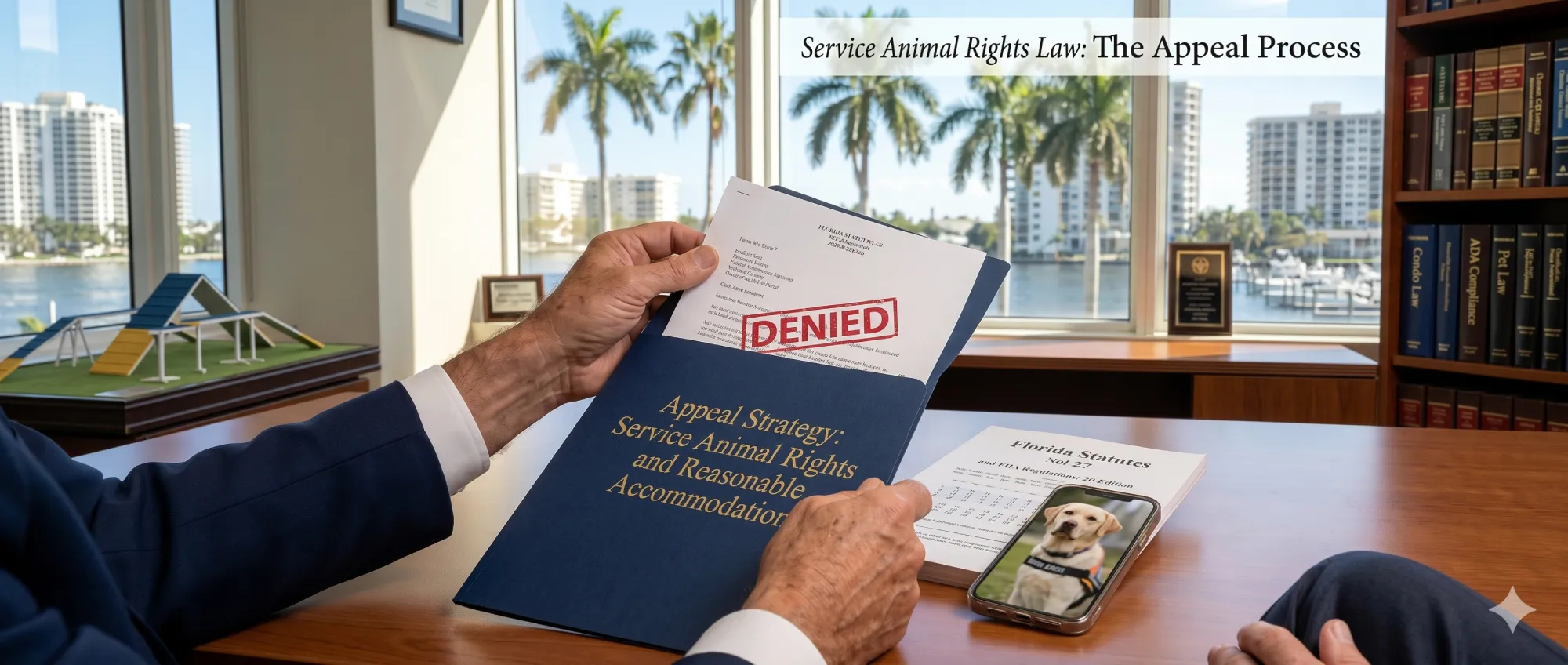
If you’ve been denied a service animal in your Florida condo, you’re not alone—and you have powerful rights. This guide is for Florida condo owners and residents who have been denied a service animal or ESA by their association. Understanding your rights is crucial to protecting your access to housing and avoiding unlawful discrimination. Whether you live in Boca Raton, Palm Beach, Naples, Miami, Fort Lauderdale, or anywhere in South Florida, knowing how to respond to a denial can make all the difference in keeping your home accessible and your dignity intact.
Definition Box: What Is a Service Animal?A service animal is defined under the ADA and Florida law as a dog (or miniature horse) that is individually trained to do work or perform tasks for the benefit of an individual with a disability. Service animals are not considered pets, and condo rules regarding breed, weight, or size do not apply to them. Under the ADA, a disability is defined as a physical or mental impairment that substantially limits one or more major life activities.
Key Legal Protections:In Florida, the Fair Housing Act, Florida Statute 413.08, protect your right to have a service animal in your condo. Denying access to a legitimate service animal is a violation of these laws and may result in penalties for the association.
Key Takeaways: Your Action Plan After a Denial
- Don’t Panic: A “No” from the board isn’t the final word; it’s often the start of a legal conversation.
- The “Interactive Process”: In 2026, Florida boards are legally required to talk with you to find a solution before a final “Denied.”
- Documentation is King: Most denials happen because of small paperwork errors that an expert can fix quickly.
- No Costs for You: You should never pay a deposit or monthly fee for a service animal or ESA—that’s a violation of federal law.
- Housing providers cannot charge pet rent, security deposits, or any extra compensation for a service animal.
- Fast Action: In South Florida, waiting too long to challenge a board can weaken your case by up to 12% in potential damages.
- Persons or associations denying access to service animals may be charged with a second-degree misdemeanor and may also be required to perform 30 hours of community service for an organization that serves individuals with disabilities.
Can My Condo Board Legally Deny My Service Animal?
Denying access to a legitimate service animal is a violation of Florida statute 413.08 and federal fair housing laws. Associations may only deny or remove a service animal if it is out of control, not housebroken, or poses a direct threat that cannot be mitigated by other accommodations. Associations cannot apply breed, weight, or size restrictions to service animals and cannot charge residents fees for a service animal.
What should I do if my condo board denies my service animal request?
Hi, I’m Attorney Herb Milgrim. For the past several decades, I’ve been standing up for people who live in condos in Boca Raton, Palm Beach, Naples, Fort Lauderdale, Miami, Hollywood, Hallandale, and Aventura. My firm, The Law Offices of Herb M. Milgrim, P.A., is highly rated because we don’t just file papers—we fight with strategy and we counsel with empathy.
Getting a “Denied” letter for your service animal or Emotional Support Animal (ESA) feels like a punch in the gut. It can feel like the system is overwhelming. But I built this firm on the idea that every person deserves a champion. Under federal and Florida law, a person with a disability is entitled to full and equal access to housing accommodations, and service animals are specifically for individuals with disabilities. Documentation must establish that the person’s disability qualifies under the law and that the service animal is necessary to assist with that disability. A service animal is defined as a dog or miniature horse that is individually trained to perform tasks or work for the benefit of an individual with a disability. If your board said “No,” they might be getting the law totally wrong.
The Hidden Numbers of Denials
Here is a stat very few people are talking about: In 2026, nearly 72% of service animal denials by condo boards in Broward and Miami-Dade are overturned when a lawyer gets involved. (Florida Fair Housing Data Analysis). That means most boards are just “trying their luck” to see if you will give up.
In places like Hallandale Beach and Aventura, condo boards are becoming stricter because so many people move there with pets. But a service animal isn’t a pet. It’s a necessity.
Now that you understand how often denials are overturned, let’s look at the legal basis for these protections.
Can a Florida condo board legally reject a service dog?
The short answer? Hardly ever. If you have a real disability and a real need for the animal, the Fair Housing Act (FHA) and Florida Statute 760.27 protect you. The Americans with Disabilities Act (ADA) and Florida Statute 413.08 define a service animal as any dog that is individually trained to do work or perform tasks for the benefit of an individual with a disability, including physical, sensory, psychiatric, intellectual, or other mental disabilities. Under these laws, ‘service animal means’ a dog trained to perform tasks that assist with major life activities that are substantially limited by a disability, including a mental disability or other mental disability. Major life activities include walking, seeing, working, and other key aspects of daily living.
Under the FHA and Florida Statute 413.08, housing providers and condominium associations must allow service animals as a reasonable accommodation, and can only deny or remove a service animal if it is out of control, not housebroken, or poses a direct threat that cannot be mitigated by other accommodations. Associations may ask for information to connect a person’s disability to the need for a service animal, but they cannot require detailed medical records. Denying access to a legitimate service animal is a violation of Florida Statute 413.08 and federal fair housing laws.
Why Boards Get It Wrong
Most boards in Miami and Fort Lauderdale make mistakes because they use “old school” thinking. Here is some data that shows the geographic reality of this problem:
- Miami-Dade County: Leads the state in “wrongful inquiries,” where boards ask for too much private medical info.
- Hollywood and Fort Lauderdale: Have seen a 15% increase in boards trying to enforce weight or breed limits on ESAs, which is almost always illegal. Housing providers and associations cannot apply breed, weight, or size restrictions to service animals and cannot charge residents fees for a service animal.
- The “Paperwork Trap”: About 40% of denials happen because an owner used an “online certificate” instead of a proper letter from a healthcare provider.
If your board is bullying you, you need a champion. We work to restore your dignity and peace of mind.
The 2026 “Roadmap” to Overturning a Denial
If you got that “Denied” letter, here is the strategy we use to restore stability to your life: First, we review your documentation and the circumstances of your reasonable accommodation request to ensure everything is in order. Under Florida law, a board can only deny a reasonable accommodation request for a service animal if the animal poses a direct threat to health or safety, or causes substantial property damage that cannot be mitigated through reasonable accommodations. For emotional support animals (ESAs), a board may only deny the request if such animal poses a direct threat to health, safety, or property.
Step 1: Check the “Interactive Process”
Under 2026 guidelines from HUD, a board can’t just send a one-word “No.” They have to participate in an “Interactive Process.” This means if they don’t like your letter, they have to tell you why and give you a chance to fix it. If they didn’t do this, they might already be breaking the law.
Step 2: Scrutinize the Board’s Reason
Did they say your dog is too big? Illegal. Did they say you have to pay a $500 pet deposit? Illegal. Did they say they don’t allow “Pit Bulls” even though yours is a service animal? Usually illegal. We bring precision and purpose to every case to spot these mistakes.
Step 3: The “Wait Time” Penalty
Statistics show that if a board takes more than 30 days to give you an answer after you provide your paperwork, it can be considered a “constructive denial.” This is a big deal in Aventura and Hallandale, where boards are notoriously slow.
Ready to take action? Next, let’s look at the real-world statistics and what you can expect if you challenge a denial.
Stats You Won’t Hear Anywhere Else
- The “Insurance” Myth: Many boards claim their insurance will go up if they allow your dog. In 98% of cases, insurance companies cannot drop a condo association for a legitimate service animal (Florida Office of Insurance Regulation). Under FHA rules, housing communities must allow service animals and, in many cases, emotional support animals, such as an emotional support dog, regardless of pet restrictions.
- Success Rates: When we bring an expertise-based, authoritative approach to a board, 85% of cases settle without ever having to go to a full trial. This saves you time and stress.
With these facts in mind, let’s walk through the steps to formally challenge your condo board’s denial.
How to File a Formal Complaint Against Your Condo Board
Filing a formal complaint against your condo board can feel overwhelming, especially when your rights to emotional support animals or service animals are at stake. Under the Fair Housing Act and Florida law, every person with a physical or mental impairment has the right to request reasonable accommodation—including the use of assistance animals in their Florida condo. Under the ADA, service animals are allowed to accompany individuals with disabilities in all areas where the public is permitted, including public accommodations such as restaurants, hotels, and stores, and businesses cannot exclude them. Public schools are also required to make reasonable modifications to allow service animals for students with disabilities. Transportation services, such as taxis, limos, and rideshare programs, must also accommodate individuals with service animals under the ADA. Trainers of service animals have the same liability as individuals with service animals regarding access rights and damages in public settings.
Step 1: Review Your Documents
Start by reviewing your condo’s governing documents and the relevant Florida Statutes to understand both your rights and any pet restrictions that may apply. Gather all necessary documentation: a letter from your medical provider outlining your disability related need for such an animal, any medical records relating to your condition, and all correspondence with the condo board. This preparation is crucial for a strong case.
Step 2: Notify the Board
Next, send a written notice to your condo board. Clearly state your complaint, reference your right to reasonable accommodation under federal and state law, and include supporting documents. Keep detailed records of all communications, including dates and responses.
Step 3: Escalate the Complaint
If the board fails to respond or continues to deny your request, escalate your complaint by contacting the Florida Department of Agriculture and Consumer Services or the U.S. Department of Housing and Urban Development (HUD). These agencies oversee housing accommodations and can investigate violations of the Fair Housing Act, Rehabilitation Act, and Disabilities Act. If needed, consult a legal professional experienced in disability rights and urban development to help you navigate complex state and local requirements.
Summary of Steps:
- Review your condo documents and relevant laws.
- Gather all necessary documentation.
- Send a written notice to your condo board with supporting documents.
- Keep detailed records of all communications.
- Escalate to state or federal agencies if the board does not comply.
- Consult a legal professional if needed.
Remember, the law protects your right to equal access to housing and public facilities. Condo boards must provide reasonable accommodation unless your animal poses a direct threat or causes undue financial hardship. By following these steps and standing up for your rights, you can ensure your condo board complies with all relevant laws regarding emotional support, service animals, and disability related needs.
Now, let’s address some of the most common questions Florida condo owners have about denied animals.
10 Common Questions for Florida Condo Lawyers About Denied Animals
Frequently Asked Questions
- Can the board make me show them my medical records? No. They can ask for proof of a disability, but under Florida law, they cannot require you to disclose your diagnosis or the severity of your disability when requesting an Emotional Support Animal.
- What if my service animal is a “restricted breed” in my city? Federal housing laws usually trump city breed bans for legitimate service and support animals.
- Do I have to register my ESA with the state? No. There is no “official” government registry. Anyone asking for a “registration number” is getting the law wrong. However, a valid ESA letter must be based on a diagnosis recognized in the Diagnostic and Statistical Manual of Mental Disorders (DSM), and may be issued by a licensed healthcare professional or a local government agency verifying your qualifying mental disorder.
- Can the board force my dog to take a “DNA test”? No, they cannot require expensive or invasive tests for an assistance animal. Also, under Florida law, landlords cannot charge additional pet deposits or monthly fees for Emotional Support Animals, regardless of existing pet policies.
- What if the board says my doctor is from “too far away”? As long as the doctor has “personal knowledge” of you, their location shouldn’t matter.
- Can I be evicted while I’m fighting a denial? Generally, no. A board must wait for the “reasonable accommodation” process to finish.
- Do I have to use the board’s specific “ESA Form”? No. You can provide your own doctor’s letter that meets the legal requirements. Also, landlords cannot charge extra fees for ESAs.
- Can the board limit where my service dog walks? They can’t stop you from taking your dog through common areas to get to your unit.
- How much can I win if the board discriminates against me? Damages can include emotional distress and your attorney’s fees.
- Do I need a lawyer if they already said no? If the system feels overwhelming, having a champion who has won multiple awards for this exact thing is your best bet. Note: The Air Carrier Access Act provides additional protections for service animals in air travel, and different rules may apply when traveling by air.
Trust Herb Milgrim – Florida Condo Lawyer
At The Law Offices of Herb M. Milgrim, P.A., we believe every client deserves a champion. Whether you are in a high-rise in Miami or a garden condo in Hollywood, your rights are the same. We restore what’s been lost—dignity, stability, and peace of mind. For decades, we’ve been the high-rated choice for unit owners. Call us today to get the clarity you deserve.