
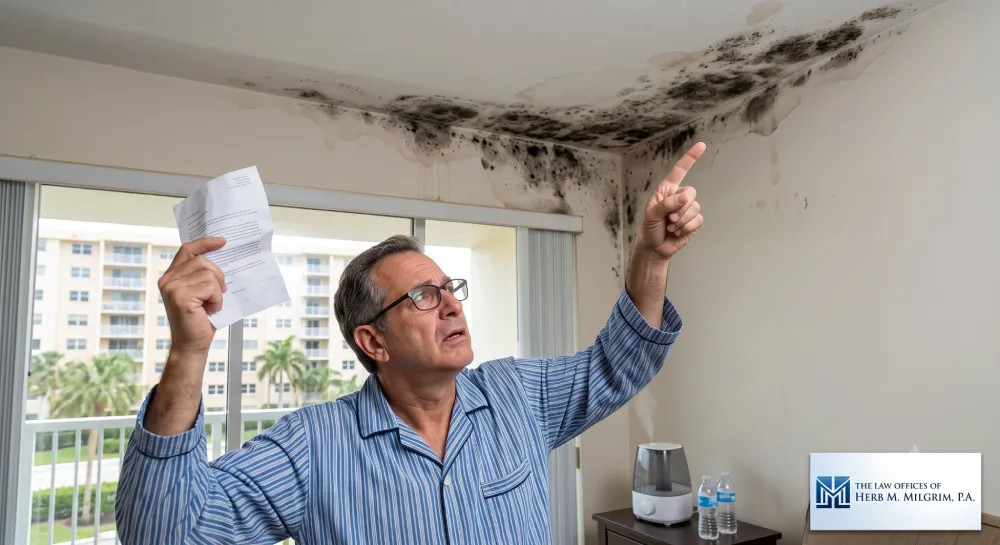
If you are dealing with toxic mold growth inside your Florida condominium because your board refuses to fix a leaking roof or a broken common pipe, your first instinct might be to stop paying your monthly maintenance fees until they resolve the issue. No, you cannot legally withhold your condo assessments in Florida under any circumstances, even if your unit is completely unhabitable due to active mold damage caused by the association’s negligence.
Florida’s Condominium Act treats the obligation to pay assessments as completely independent of the board’s duty to maintain the property. If you choose to hold back your maintenance fees as leverage, the association can legally place a lien on your property under Florida Statute § 718.116, charge you 18% interest plus costly administrative fees, suspend your voting rights, and ultimately file a foreclosure lawsuit to take your condo away from you.
Key Takeaways for Mold-Impacted Condo Owners
- Assessments Are Absolute: Florida courts have ruled repeatedly that there is no “self-help” right to withhold condo dues; a board’s failure to perform repairs does not excuse an owner’s failure to pay assessments.
- The Association’s Maintenance Mandate: While you cannot withhold funds, the association is legally bound by Florida Statute § 718.113(1) to maintain, repair, and replace all common elements, which includes the structural source of your water intrusion and toxic mold.
- The Immediate Action Step: Keep paying your assessments in full, but immediately send a formal, written “Notice of Intent to File Suit” for negligence and breach of statutory duty, perform an independent, licensed mold assessment of your unit, and retain a consumer-focused attorney to force the board’s hand.
The Dangerous Trap of Withholding Maintenance Fees in Florida
It is completely understandable to feel furious when you are writing a check every single month to an association that ignores water leaking through your ceiling, creating a hazardous environment for your family. However, the legal system in Florida does not give condominium owners the same “rent-withholding” rights that tenants have against private landlords.
In Florida condominium law, assessments are considered the lifeblood of the entire community. If individual owners could unilaterally stop paying their fees every time a dispute arose, the association could go bankrupt, leaving the building unable to pay for utilities, property insurance, or critical safety measures.
If you drop behind on your payments for more than 90 days, the board can accelerate your dues for the entire year, bar you from entering community amenities, and hand your account over to their collection attorneys. Suddenly, a dispute over a $3,000 mold remediation job transforms into a fight against a foreclosure action targeting your entire home investment. You cannot use the board’s maintenance failures as a legal defense to cancel out what you legally owe the association.
Identifying the Source: Who is Legally Responsible for the Mold?
To force your board to pay for mold cleanup and structural repairs without putting your property at risk, you must identify exactly where the moisture is coming from. Under the Florida Condominium Act, financial responsibility is dictated strictly by the physical origin of the water intrusion.
[Water Intrusion Event Occurs]
│
┌───────────┴───────────┐
▼ ▼
[Common Element Source] [Unit-Interior Source]
(Roof, Stacks, Outer (Appliance, Private
Drywall, Main Pipes) HVAC, Inside Lines)
│ │
▼ ▼
[Association Escapes [Owner Responsible for
Deductible; Remediates Remediation & Repair]
Insured Infrastructure]
1. When the Association Must Remediate
Under Florida Statute § 718.113(1), the association is responsible for maintaining all common elements. If toxic mold grows inside your walls because of a leaking roof, a failed exterior building facade, or a burst main plumbing stack serving multiple units, the association is legally obligated to address the root cause. Furthermore, under Florida Statute § 718.111(11)(f), the association’s property insurance policy must cover the structural drywall and framing inside your unit as originally constructed.
2. When the Unit Owner Must Remediate
If the water intrusion is caused by an issue originating entirely within your unit boundaries—such as a leaking dishwasher hose, a backed-up individual HVAC condensate line, or an appliance overflow—you are financially responsible for the cleanup. In these cases, you must utilize your individual HO-6 homeowner’s insurance policy to cover the interior finishes and mold mitigation.
The Negligence Shift: How Board Delay Changes the Legal Equation
There is a common misconception among property management companies in South Florida and coastal regions—across Palm Beach County, Broward County, Miami-Dade County, Collier County, and Pinellas County—that the association only has to replace the bare drywall, leaving the owner to pay for everything else.
This is flatly incorrect if the board was negligent.
If you notify your board in writing of a common element leak, and they drag their feet, ignore your emails, or perform a cheap, temporary patch that fails, their delay constitutes a breach of fiduciary duty. Under Florida law, when an association is negligent in maintaining a common element after receiving proper notice, they can be held legally responsible for all consequential damages. This includes:
- The full cost of licensed mold remediation inside your living spaces.
- Replacing ruined kitchen cabinets, baseboards, and flooring.
- Alternative living expenses (hotel costs) if your unit is deemed a biohazard.
- Your testing costs, court costs, and reasonable attorney fees.
A landmark ruling by Florida’s Fourth District Court of Appeal (McLlenan v. Cypress Chase, 2024) solidified this principle. The court affirmed that a condo association has a non-delegable duty to maintain common elements and address water damage issues, completely shutting down the common excuse boards use to deflect blame onto neighboring units.
Do Not Wait: The Strategic Steps to Fight Board Inaction Safely
If you are dealing with active mold growth in cities like Boca Raton, Naples, Miami, Fort Lauderdale, Sunny Isles, or Sarasota, sitting back and waiting for the board to act will destroy your case. For every week you delay taking action, you risk harming your health and compromising your legal position due to a failure to mitigate damages.
Here is the exact framework you must follow to build an airtight legal claim while protecting your property:
Step 1: Document and Test via a Licensed Professional
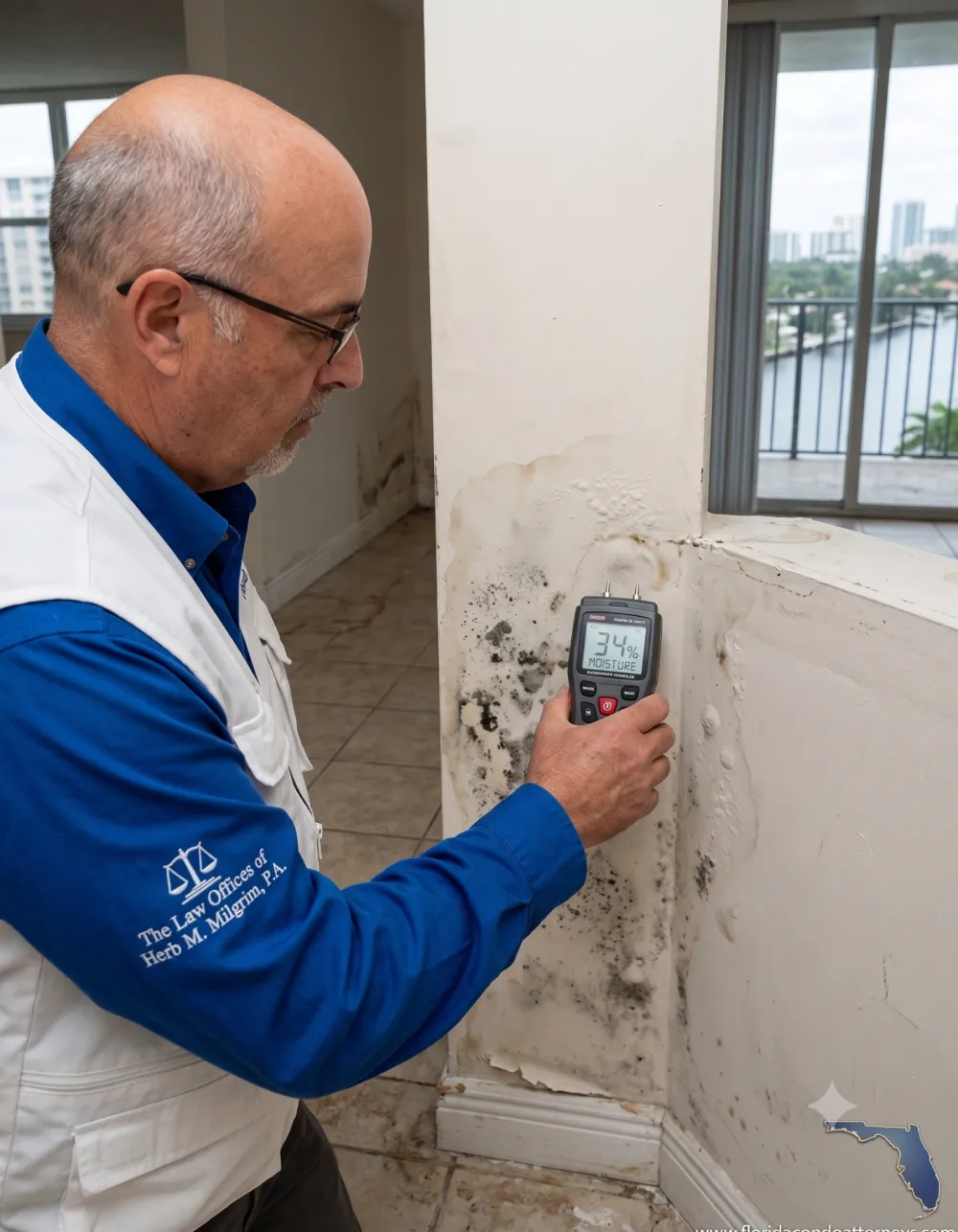
Do not let the board send their generic handy-man to wipe down your walls with bleach. Under Chapter 468 of the Florida Statutes, any mold remediation or assessment affecting an area larger than 10 square feet must be performed by a DBPR-licensed mold professional. Hire an independent, licensed mold inspector to perform air sampling and infrared moisture mapping. This report serves as your primary legal evidence, proving the exact spore counts and tracking the water back to the board’s structural property.
Step 2: Provide Mandatory Statutory Written Notice
Send a formal written letter to the board via certified mail with return receipt requested. Explicitly outline the source of the water, attach your professional mold report, and formally demand that they initiate repairs within a specific, reasonable window. This satisfies your legal obligation to report the loss immediately and starts the clock on the board’s liability for ongoing delay.
Step 3: Utilize Statutory Record Requests to Uncover the Truth
If your board claims they don’t have the funds to fix the building infrastructure, force them to open their books. Under Florida Statute § 718.111(12), you have the right to inspect the association’s official records, including structural integrity reserve studies (SIRS), past engineering reports, and maintenance logs. If the board fails to provide access to these records within 10 business days of your written request, they owe you a statutory penalty of $50 per day, up to a maximum of $500.
Why You Need a Consumer-Only Litigation Attorney
Condo boards maintain expensive law firms on retainers, using your own monthly assessment dollars to fight your claims, delay repairs, and tie you up in bureaucratic red tape. They count on individual owners running out of money or getting terrified by threats of property liens.
That is why The Law Offices of Herb M. Milgrim, P.A. maintains an unyielding practice model: We exclusively represent individual unit owners and homeowners. We never represent condominium associations or HOA boards.
We believe that professional representation is about balancing the scales of justice when an aggressive board uses its power to trample on your rights. Founded by Attorney Herb Milgrim, our firm brings over a decade of award-winning litigation experience straight to the defense of individual property owners. We know how to expose negligent boards, pierce through property management excuses, and compel compliance under the Florida Condominium Act.
Keep your assessment account perfectly current so the board cannot claim the legal high ground, and let us handle the courtroom strategy to restore your property, your health, and your peace of mind.
Frequently Asked Questions About Condo Mold and Assessments
1. Can I pay my condo assessments into a court registry or escrow account during a mold dispute?
No. Unlike landlord-tenant law, there is no statutory mechanism in Florida condominium law that allows a unit owner to escrow or deposit maintenance fees into a separate account while waiting for common element repairs to be completed.
2. What happens if I pay my assessments under protest?
Paying “under protest” keeps your account legally current, which completely strips the board of their ability to file a foreclosure lien against you. It preserves your right to sue the association for damages without giving them a counter-claim for unpaid dues.
3. Is the condo board responsible for removing mold from my personal furniture?
If the mold was caused by a sudden, accidental plumbing burst, you generally must use your own HO-6 insurance for personal property. However, if the mold resulted from long-term board negligence and a failure to fix a known roof leak, the board can be held liable for your personal property losses.
4. Can an association force me to pay a special assessment for mold repairs caused by their own neglect?
Yes, initially. The board can pass a special assessment to cover building-wide repairs. However, if their individual negligence specifically targeted and damaged your unit, you have the right to seek reimbursement for your out-of-pocket costs through a civil lawsuit.
5. My property manager says the board isn’t responsible for “walls-in” mold. Is that true?
No. While Florida Statute § 718.111(11) divides insurance obligations, a board cannot use insurance boundaries to escape liability for physical negligence. If their failed roof caused the mold inside your walls, they are responsible for the remediation of that damage.
6. Can I hire my own mold contractor and deduct the cost from my monthly dues?
Absolutely not. Deducting repair costs from your maintenance assessments will trigger an automatic late fee, a potential claim of lien, and eventual foreclosure proceedings by the association’s legal counsel.
7. How long does a condo board have to respond to a written report of toxic mold?
While the statute does not list a specific number of days, Florida courts apply a “reasonable time” standard based on emergency circumstances. Because toxic mold poses an immediate health risk, a delay of more than a few weeks to initiate an inspection is typically deemed legally unreasonable.
8. What is a Loss Assessment endorsement, and do I need it for mold claims?
A Loss Assessment endorsement is a critical addition to your personal HO-6 insurance policy. If your association passes a massive community-wide special assessment to pay for structural mold remediation or building deductibles, this coverage helps pay your individual share.
9. Can the condo board fine me if mold from my unit spreads to a common hallway?
Only if the source of the mold was your individual, unmaintained appliance or personal property. If the mold spread because you ignored an internal line leak, you could be liable; if it spread due to a structural leak, the board cannot fine you.
10. Do I have to go through arbitration before suing my condo board for mold negligence?
No. Under current Florida law, claims involving an association’s breach of fiduciary duty, property damage, and negligence regarding common element maintenance can be filed directly in a Florida Circuit Court without undergoing mandatory DBPR arbitration.