
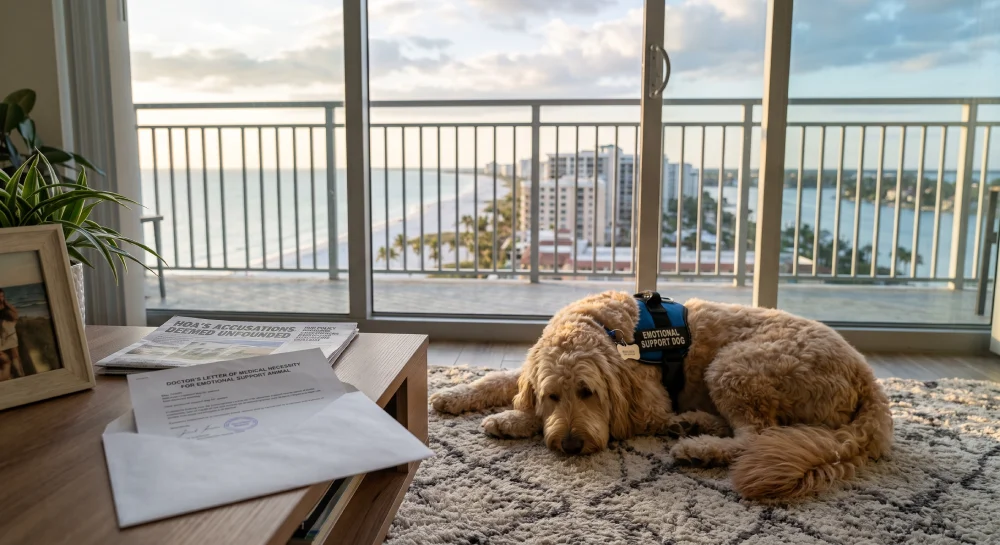
Yes, your Florida condo board can legally reject a generic online ESA certificate and report you for a second-degree misdemeanor if the documentation is fraudulent. Under Florida Statute § 760.27, submitting a fake or “instant-approval” ESA letter to bypass building pet rules is a crime, giving aggressive associations the ammunition they need to deny your animal and threaten legal action.
If your Homeowners Association (HOA) or condo board is scrutinizing your emotional support animal paperwork, looking for any excuse to call it fake, you are stepping into a legal minefield. Boards despise being forced to waive their strict “no pets” rules. They are actively hunting for owners who use cheap, $40 internet certificates so they can reject the accommodation and punish the owner.
At The Law Offices of Herb M. Milgrim, P.A., we know exactly how to defeat these board tactics. We exclusively represent individual Condo Owners and Homeowners. We NEVER represent HOAs or Condo Boards. Our sole mission is to protect consumers against board overreach and ensure your legitimate medical rights are respected.
Key Takeaways
- Your Core Legal Right: Florida law protects your right to an emotional support animal and waives pet restrictions, but only if your medical letter comes from a qualified healthcare practitioner who has personal knowledge of your disability.
- The Board’s Limit: While a board can reject a worthless internet certificate, they cannot deny a legally compliant ESA letter, demand your underlying medical records, or use recent federal policy changes to ban your untrained support animal.
- Your Immediate Action Step: If your board accuses you of ESA fraud or rejects your medical letter, do not argue with the property manager or buy another certificate online; contact an attorney who exclusively represents owners to aggressively enforce your state rights.
Does the May 2026 HUD Policy Reversal Make All Untrained ESAs Illegal in Florida?
No, the May 22, 2026 HUD policy reversal does not make untrained emotional support animals illegal in Florida. While the federal government restricted its enforcement to trained service animals, Florida state law independently and strictly protects your right to an untrained emotional support animal.
On May 22, 2026, the U.S. Department of Housing and Urban Development (HUD) threw a massive curveball at condo owners. It issued an internal memo stating that its federal enforcement office would no longer automatically investigate housing discrimination complaints involving untrained assistance animals. Instead, HUD shifted its focus strictly to animals that are individually trained to perform specific tasks, similar to the ADA standard.
Overnight, HOA attorneys and property managers seized upon this memo. Boards across Sunny Isles, Miami, and Aventura began sending out letters claiming that “HUD changed the rules” and that all untrained ESAs are now banned. They are intentionally misleading you. HUD’s internal enforcement shift did not rewrite the Fair Housing Act, nor did it erase state-level protections.
If your association in Sarasota or Pompano is using this federal memo to accuse you of keeping an “illegal” or “fake” ESA, they are banking on your ignorance. Florida state law provides a complete shield against this board manipulation, provided your documentation is bulletproof.
What Does Florida Statute § 760.27 Require for a Valid ESA Letter?
Florida Statute § 760.27 requires a licensed healthcare practitioner with personal knowledge of your disability to issue your ESA letter. The law explicitly states that an identification card, patch, or certificate obtained solely online is never legally sufficient on its own.
Florida lawmakers realized that the internet was flooded with “ESA mills”—websites where you pay a small fee, fill out a five-minute multiple-choice quiz, and instantly download a certificate. To combat this, they passed a strict law. You can read the exact requirements directly via the Florida Senate Online Sunshine database.
To avoid the “Fake ESA” trap, your letter must come from a doctor, psychiatrist, or telehealth professional licensed to treat you. This practitioner must establish a real clinical relationship with you. They must have personal knowledge of your disability and state clearly that the animal provides necessary therapeutic emotional support that alleviates a symptom of that disability.
If you live in a high-rise in Boca Raton or Naples, handing your property manager a flashy ID card you bought online is a massive mistake. Not only will the board legally reject your animal, but under Florida Statute § 760.27, knowingly providing fraudulent ESA documentation is a second-degree misdemeanor. Aggressive boards will not hesitate to report you to local authorities just to force you out.
How Do Overzealous Condo Boards Weaponize the “Fraud” Label Against Legitimate Owners?
Condo boards weaponize the fraud label by instantly rejecting perfectly valid ESA letters from licensed doctors, falsely claiming the documents are fake simply because they do not want animals in the building. They use the threat of criminal misdemeanor charges to bully and intimidate stressed residents into giving up their prescribed support animals.
Across Palm Beach County, Collier County, Pinellas County, Broward County, and Miami-Dade County, we are seeing a disturbing trend. Property managers are playing doctor. They will look at a legitimate letter from a licensed Florida telehealth psychiatrist and arbitrarily declare it a “fake internet letter”.
Boards in Fort Lauderdale, Hollywood, and Hallandale are demanding that owners sign invasive HIPAA releases and provide access to private psychiatric records to “prove” the owner is not committing fraud. They will threaten to levy massive daily fines, tow your car, or even file an eviction lawsuit, claiming you are harboring an unauthorized, illegal pet.
They do this because intimidation usually works. They expect you to fear the “fraud” label and back down.
How Do I Protect Myself and My Animal from an Abusive Florida Condo Board?
You protect yourself by refusing to argue with the property manager and immediately hiring a veteran consumer-rights attorney to enforce your valid ESA letter. Filing a state-level discrimination claim forces the board to back down, approves your animal, and exposes the association to severe financial damages for their harassment.
When a board denies a valid ESA letter by falsely accusing you of fraud, they are committing housing discrimination. Trying to defend yourself at a hostile board meeting will only give their HOA attorney more ammunition.
At The Law Offices of Herb M. Milgrim, P.A., we turn the tables on abusive boards. We review your documentation to ensure it is ironclad under state law. Then, we step between you and the association. We notify their legal counsel that their rejection violates Florida civil rights laws. We don’t ask for permission for your dog or cat to live with you; we demand compliance.
If your condo board in Palm Beach is threatening you over your ESA paperwork, do not panic and do not buy another useless online certificate. Review our practice pathways and contact us today. Let us fight the board so you can live in peace.
Frequently Asked Questions
- Is an ESA registration certificate I bought online legally valid in Florida?
No. Florida Statute § 760.27 explicitly states that a certificate, ID card, or patch bought from the internet is not sufficient proof of a disability. You need a letter from a qualified healthcare practitioner.
- What happens if I accidentally give my condo board a fake online ESA letter?
If a board determines the letter is fraudulent, they can legally reject your accommodation request. Furthermore, knowingly providing fraudulent ESA documentation is a second-degree misdemeanor in Florida.
- Does my doctor have to be located in Florida to write my ESA letter?
The practitioner must be licensed to provide services to you in your jurisdiction. Telehealth providers are perfectly legal, provided they have established a legitimate clinical relationship and have personal knowledge of your disability.
- The board says the May 2026 HUD memo means my ESA needs training. Is that true?
No. While the May 2026 HUD memo shifted federal enforcement toward trained service animals, Florida state law (F.S. § 760.27) continues to strictly protect untrained emotional support animals.
- Can my HOA force my doctor to fill out a custom medical questionnaire?
No. A board cannot demand that your healthcare practitioner use a specific, custom-drafted form, nor can they demand notarized statements under Florida law.
- Can the property manager call my doctor to verify my ESA letter?
They can contact the practitioner’s office solely to verify that the practitioner actually authored the letter. They cannot ask questions about your specific diagnosis, symptoms, or medical history.
- Can my condo board charge me a “pet deposit” if my ESA letter is valid?
Absolutely not. Under Florida law, if your ESA request is valid, the board cannot charge you pet fees, pet rent, or pet deposits, because an ESA is not legally classified as a pet.
- Can a board reject my ESA because my dog is over the building’s 20-pound weight limit?
No. Legitimate emotional support animals are exempt from building breed, size, and weight restrictions.
- What if my disability is obvious, like I am in a wheelchair? Do I still need an ESA letter?
If your disability and the disability-related need for the animal are readily apparent, the board may not request additional medical documentation.
- Why shouldn’t I just use the condo association’s attorney to mediate this?
The association’s attorney is paid to protect the board, not you. They are actively looking for ways to reject your request. You need independent counsel who exclusively represents individual condo owners to protect your rights.