
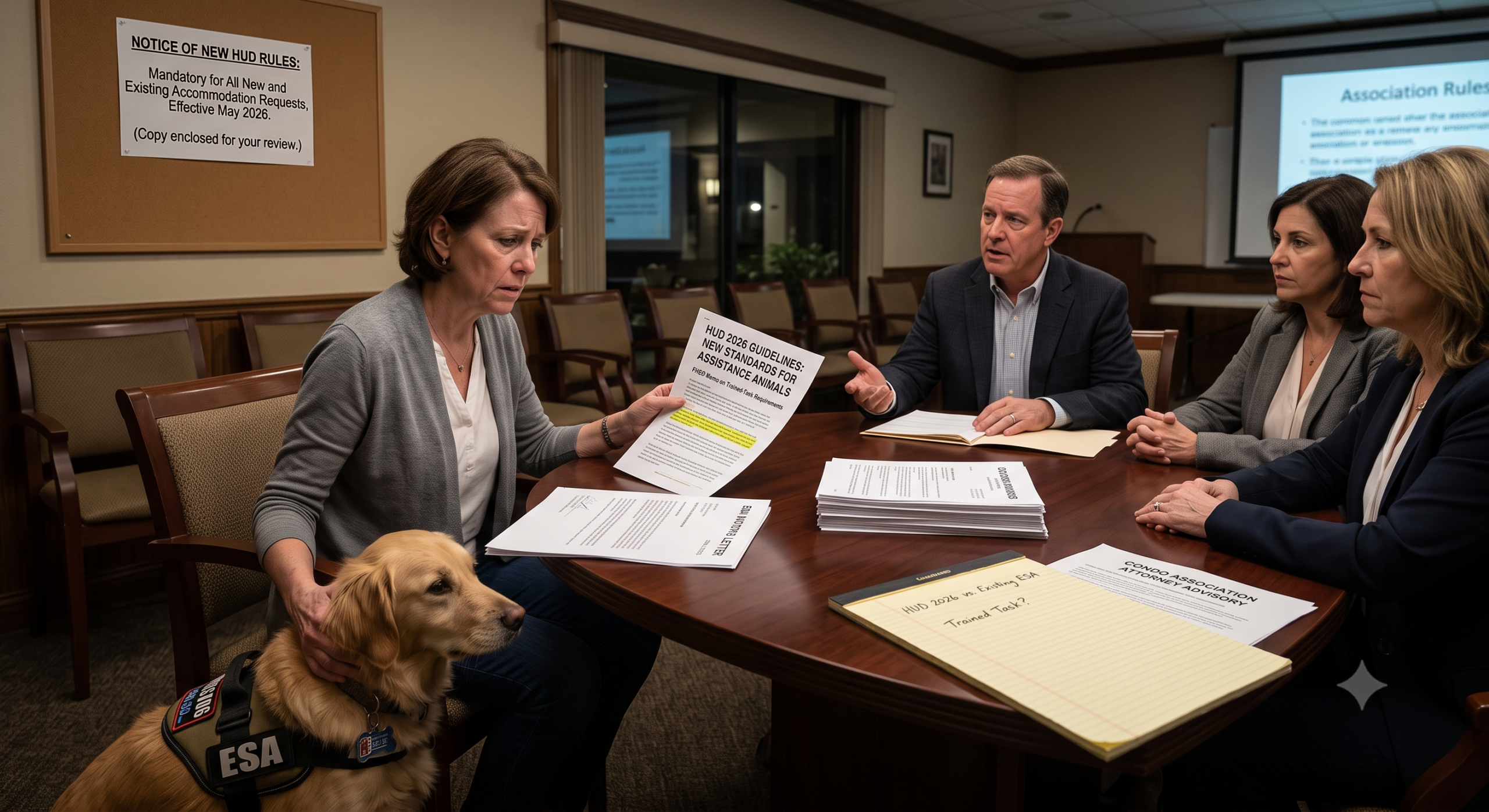
If your Florida condo board is suddenly threatening to audit, revoke, or sue you over an Emotional Support Animal (ESA) that they already approved, you are likely feeling blindsided and anxious. No, your condo board cannot legally use the recent 2026 HUD enforcement memorandum to retroactively revoke their approval or sue you to force your existing ESA out of your home.
On May 22, 2026, the U.S. Department of Housing and Urban Development (HUD) fundamentally shifted its internal enforcement priorities by permanently rescinding its 2020 guidance and stating it will no longer administratively prosecute housing providers over untrained ESAs. However, this internal agency memo did not change federal statutory law, it did not overturn decades of judicial precedent, and it absolutely does not erase your ironclad protections under Florida State Law.
Key Takeaways for Stressed Condo Owners
- Existing Approvals Are Vested Rights: Once a condo board officially grants a reasonable accommodation for your ESA, that approval is a binding legal agreement that cannot be retroactively cancelled just because an internal federal agency changed its investigative policy.
- Florida Statutory Law Expressly Protects ESAs: Even if federal administrative avenues have narrowed, state laws are completely intact. The Florida Statute § 760.27 framework explicitly mandates that housing providers must accommodate untrained emotional support animals.
- The Immediate Action Step: If your board sends you a letter demanding “proof of training” for an existing ESA or threatens a retroactive review, do not panic and do not volunteer your private medical records. Send a formal written response stating that your animal’s accommodation is already approved and is fully protected under Florida law, then contact an attorney who exclusively fights for consumers.
Why Is Your Board Suddenly Weaponizing the May 2026 HUD Memo?
Many condominium association boards and aggressive HOA lawyers throughout South Florida and the Gulf Coast—spanning Palm Beach County, Broward County, Miami-Dade County, Collier County, and Pinellas County—are intentionally misinterpreting the news. They are reading headlines about HUD’s policy change and mistakenly believing they now have a green light to purge animals from “no-pet” communities.
To understand why they are wrong, you have to look at what HUD actually did. As detailed by civil rights advocates tracking the May 22, 2026, HUD Policy Reversal, the federal agency instructed investigators to only find “reasonable cause” in fair housing complaints where an assistance animal has been individually trained to perform specific tasks. Essentially, HUD closed its own administrative doors to new complaints regarding untrained ESAs.
But here is the critical part that your board’s lawyer is ignoring: HUD does not make laws; Congress does. The federal Fair Housing Act itself has not been amended. More importantly, federal agency memos cannot override explicit Florida state statutes.
The Florida Shield: How Florida Statute § 760.27 Protects Your Approved ESA
While your board might think they are operating under federal guidelines, they are bound by the laws of the State of Florida. Under Florida Statute § 760.27, the state defines an emotional support animal as:
“…an animal that does not require training to do work, perform tasks, provide assistance, or provide therapeutic emotional support by virtue of its presence which alleviates one or more identified symptoms or effects of a person’s disability.”
Florida law explicitly acknowledges that ESAs do not require training. Because your condo is located in Florida, the board must comply with state civil rights laws regardless of what a federal agency chooses to prioritize in its administrative backlogs. If a board in Boca Raton, Naples, or Sunny Isles attempts to retroactively apply a “training standard” to your existing ESA, they are committing an independent act of housing discrimination under Florida law.
Can an Association Sue to Overturn a Past Accommodation?
For a condo board to successfully sue you in state court to remove an animal they already approved, they would have to prove that your medical necessity has somehow vanished, or that your animal has become a direct, documented threat to the structural safety or physical health of the residents.
They cannot simply say, “The rules changed in Washington, so your approval is void.”
In contract and property law, once an association reviews your medical documentation, accepts your request, and issues an approval, you have an equitable right to rely on that accommodation. Attempting to reverse that decision without a severe behavioral violation by the animal constitutes bad faith and breach of fiduciary duty.
At The Law Offices of Herb M. Milgrim, P.A., we see boards try this exact intimidation tactic constantly in heavily populated condo zones like Miami, Fort Lauderdale, Hollywood, Hallandale, Sarasota, and Pompano. They issue aggressive violation notices hoping you will get scared and give up your animal. We make sure they don’t get away with it.
What a Condo Board Can and Cannot Legally Demand Under Florida Law
If your board attempts to launch an “audit” of your existing ESA, you must know your statutory boundaries so you don’t accidentally compromise your rights.
What the Board is Strictly Forbidden From Doing:
- No Demands for Medical Records: Under Florida Statute § 760.27(3)(a), a housing provider is explicitly banned from requesting information that discloses your specific diagnosis, the severity of your disability, or any of your actual medical records.
- No Mandatory Special Forms or Notarization: Your board cannot force you to fill out their custom medical forms or demand notarized statements. If they try to deny your accommodation or force an audit because your doctor refuses to sign their specific liability waiver, they are breaking state law.
- No Retroactive Breed, Weight, or Fee Mandates: They cannot suddenly decide your approved 45-pound dog violates a 25-pound pet limit, nor can they charge you “retroactive pet rent” or a pet deposit.
What the Board Can Legally Enforce:
- Local Health and Safety Compliance: The board can require proof that your ESA is up to date on its local county vaccinations and rabies licensing.
- Actual Nuisance Behavior: If an animal is constantly barking, roaming unleased in common areas, or acting aggressively toward neighbors, the board can take action based on behavioral disruption—but never simply because the animal is an ESA.
The Danger of the “Internet Certificate” Audit
One legitimate reason a board might look closely at an animal is if the original approval was based solely on a PDF certificate bought from an online registry website. Florida Statute § 760.27(3)(c) explicitly states that an online ESA registration, patch, or ID card by itself is not sufficient to establish a disability-related need.
If your initial approval was backed by a real letter from a treating clinical professional, you are safe. If your board is attempting to use the 2026 climate to target your paperwork, it is vital to secure an evaluation from a legitimate, licensing-compliant professional. For out-of-state healthcare practitioners providing your documentation, Florida law requires that they must have provided in-person care or services to you on at least one occasion. If you are using an in-state telehealth provider, they must be in good standing with Florida’s regulatory bodies.
Why You Need a Consumer-Only Advocate in Your Corner
When a condo board threatens legal action, the playing field feels completely uneven. Property management companies and association boards have deep pockets funded by your own monthly assessments, and they employ aggressive law firms whose entire business model relies on bullying individual unit owners.
That is why our firm operates on a strict foundational policy: We exclusively represent individual condo owners and homeowners. We never represent HOAs or condo boards.
We believe great representation is about standing up for individuals when the odds are heavy and the system feels completely overwhelming. Founded by Attorney Herb Milgrim, our firm ensures that you have a dedicated champion to protect your peace of mind, your rights, and your devoted companion animal under the Florida Condominium Act.
If your board is sending you threatening letters, don’t try to handle it alone. We know their playbooks, we understand the exact mechanics of the law, and we know how to shut down unlawful board overreach before it escalates to an expensive courtroom battle.
Frequently Asked Questions About Florida Condo ESA Laws
1. Does the May 2026 HUD memo mean ESAs are no longer legal in Florida condos?
No. The memo only changes the types of cases HUD’s internal administrative branch chooses to investigate. The federal Fair Housing Act itself remains unchanged, and Florida Statute § 760.27 explicitly protects your right to have an untrained ESA in a housing unit.
2. Can my condo board force me to re-apply for my ESA every year?
No. Once a reasonable accommodation is granted for a permanent disability, the board cannot force you to undergo an annual re-certification or application process unless they have explicit, documented evidence that your disability-related need has fundamentally changed.
3. Can a board fine me for having an ESA if the building has a “no-pets” policy?
An approved ESA is legally classified as an assistance animal, not a pet. Therefore, a building’s restrictive “no-pets” covenants or weight limitations do not apply to your animal, and any fines levied against you for possessing the animal are completely illegal.
4. What should I do if my board sends me an enforcement letter referencing the new HUD guidelines?
Do not ignore it. Send a polite, written response stating that your animal is an approved accommodation under both the Fair Housing Act and Florida Statute § 760.27, and state that you are consulting with legal counsel. Contact a consumer condo attorney immediately to handle the response.
5. Can my board evict me or force my animal out while a dispute is being discussed?
No. A condo board cannot summarily evict you or remove your animal without due process, which requires formal notice, an opportunity to be heard, and typically a mandatory pre-suit mediation process before they can ever file a lawsuit in a Florida court.
6. Can the board require my doctor to speak with the association’s attorney?
Absolutely not. Your healthcare provider is bound by privacy laws, and your board has no legal right to demand a deposition, phone consultation, or cross-examination of your treating physician as a condition of keeping your approved animal.
7. Are indoor emotional support cats subject to the same rules as dogs?
Yes. Florida Statute § 760.27 applies to emotional support animals, not just dogs. As long as you have the proper documentation supporting the therapeutic need for the animal, an indoor cat is afforded the exact same legal protections.
8. Can my board charge me a higher monthly maintenance fee because I have an ESA?
No. Charging an extra fee, a higher insurance premium, or an elevated security deposit for a documented assistance animal is a direct violation of Florida civil rights laws.
9. What happens if my ESA barks occasionally? Will I lose my legal protections?
Normal, occasional domestic animal behavior is expected. However, if your animal exhibits unmanaged, continuous nuisance behavior that disrupts the quiet enjoyment of other residents, the board can take action based on the behavior, though they must document the disruptions extensively.
10. Can I sue my condo board if they harass me over my approved ESA?
Yes. If your board engages in targeted harassment, improperly threatens fines, or creates a hostile living environment because of your disability accommodation, you have a private right of action to sue them in state court for damages and injunctive relief.