
Introduction: What This Page Covers and Who It’s For
Welcome to your comprehensive guide on Florida condo mold litigation. This page is designed for Florida condominium owners, and tenants who are facing—or want to prevent—mold problems in their buildings. Here, you’ll find clear explanations of the legal risks, owner rights, and litigation strategies related to mold in Florida condominiums. Understanding these issues is crucial because mold can threaten your health, property value, and legal standing. Whether you’re dealing with a current mold issue or want to be prepared, this resource will help you navigate the complexities of Florida condo law and protect your interests.
Summary: What Are My Legal Rights and Risks if I Have a Mold Problem in My Florida Condo?
If you discover mold in your Florida condo, your legal rights and risks depend on where the mold originates and how quickly you act. Mold litigation in Florida condominiums often centers on the critical distinction between common elements and individual unit interiors, governed primarily by Chapter 718 of the Florida Statutes (The Florida Condominium Act). Florida Statute §718.303 allows unit owners to take legal action against the association for failure to comply with the Condominium Act or the governing documents, including claims for damages due to unreasonable delays in maintenance. If a condominium association fails to maintain common elements, leading to water intrusion and mold damage, unit owners may have a negligence claim against the association under Florida law. Florida law addresses mold issues in condominium properties primarily by allocating repair duties based on the source of moisture intrusion and establishing licensing regulations for mold treatment. Acting quickly and documenting the problem is essential to protect your rights and maximize your potential recovery.
Background: How Florida Law Addresses Mold in Condominiums
Florida law does not have a standalone mold statute; liability is governed by Chapter 718 of the Florida Statutes (The Condominium Act). The Florida Condominium Act is the primary legal framework that regulates the rights and responsibilities of condominium associations and unit owners. Under this Act, repair and maintenance duties are allocated based on the source of moisture intrusion. Associations are generally responsible for common elements, while unit owners are responsible for their own units. Additionally, Florida law establishes licensing regulations for mold assessment and remediation professionals to ensure proper handling of mold issues.
Definition: What Are “Common Elements” in a Florida Condominium?
Under Florida Statute §718.113(1), condominium associations are responsible for the maintenance, repair, and replacement of common elements, which include roofs, exterior walls, and shared plumbing systems. Common elements are the parts of the condominium property that are not part of the individual units and are shared by all owners. The association’s responsibility for these areas is a key factor in determining liability for mold problems.
Key Takeaways: Why You Must Report Condo Mold Now
- Waiting is Losing: For every 10 days you delay reporting mold, you statistically lose over 3% of your potential damage recovery.
- The Board’s “Duty”: Florida law says your condo board must act like a “careful person” (fiduciary). If they don’t fix the source of the mold, they are likely breaking that duty.
- Association Responsibility: Under Florida’s Condominium Act (Fla. Stat. §718.113(1)), the condominium association is responsible for maintaining, repairing, and replacing common elements—unless the condominium declaration or other governing documents state otherwise.
- Proving Negligence: In 93% of mold cases in Miami-Dade and Broward, the board’s negligence is the number one thing you must prove.
- South Florida is a Hotspot: About 15.4% of mold cases in the US come from just three Florida counties—Miami-Dade, Broward, and Palm Beach.
- Support Animals are Not “Pets”: Don’t let your board bully you. If you have a disability, they must generally make a “reasonable accommodation” for your support animal under the Fair Housing Act (FHA).
Now, let’s explore the specific legal risks of waiting to report mold in your Florida condo.
What are the Legal Risks Under Florida Law of Waiting to Report Condo Mold in Florida?
Hi, I’m Attorney Herb Milgrim. For decades, I’ve been a champion for individual condo owners living in places like Fort Lauderdale, Miami, Hollywood, Hallandale, and Aventura. My firm, The Law Offices of Herb M. Milgrim, P.A., is highly rated and has won multiple awards. We counsel with empathy to restore what’s been lost—dignity, stability, or peace of mind.
We know that a mold problem is more than just ugly and smelly. It’s a risk to your health, your money, and your legal rights. If you smell that musty scent, your “silence” could be a legal nightmare. We don’t just file motions; we counsel with empathy to build a winning strategy.
Association vs. Owner Responsibility
Florida law allocates responsibility for mold remediation based on the source of the moisture intrusion. If the mold is caused by a failure of a common element—such as a leaking roof, exterior wall, or shared plumbing—the association is typically responsible for repairs and remediation. If the source is within your unit (like a leaking appliance), the owner is responsible. This distinction is crucial in determining who pays for repairs and who may be liable for damages.
Insurance Coverage in Mold Disputes
When it comes to responsibility for repairs, under Fla. Stat. §718.111(11), the association must insure the condominium property as originally constructed, while unit owners are responsible for their own HO-6 policies covering personal property and interior finishes. Insurance coverage disputes often arise in mold cases, so it’s important to review your policy and the association’s master policy to understand what is covered.
Steps to Take When Mold is Discovered
If you discover mold in your condo, take these steps immediately:
- Document the Problem: Take photographs, videos, and notes of the affected areas.
- Notify the Association in Writing: Send a formal written notice to the board identifying the source of the mold and requesting prompt action.
- Request Inspection Reports: Ask for any recent inspection or maintenance reports related to the common elements.
- Obtain a Professional Mold Assessment: Hire a licensed mold assessor to determine the source and extent of the problem.
- Mitigate Damages: Take reasonable steps to prevent further damage, such as running dehumidifiers or temporarily sealing leaks.
- Keep a Paper Trail: Save all correspondence, reports, and receipts related to the mold issue.
Delaying these steps can weaken your legal position and reduce your potential recovery.
Transitioning from understanding your immediate risks, let’s look at the broader responsibilities of your condo board and how their actions—or inaction—can impact your case.
Can a Condo Board in Florida Get in Trouble for Association’s Failure to Maintain a Mold Source?
This is one of the most important questions you can ask. In South Florida, we love our sunshine, but we know it means high humidity. In 2026, many older coastal buildings are facing major problems. The average yearly maintenance increase in South Florida has been over 20% since 2021 (Community Associations Institute). A lot of that money should be going toward repairs that prevent mold. However, an association’s failure to maintain common elements can lead to water intrusion and mold, creating legal liability for the association. The governing documents of the condominium define these maintenance responsibilities and outline how disputes are resolved.
Real-World Statistics and Legal Framework
- Florida is a Mold Problem State: About 15.4% of all national mold litigation originates in just three counties: Miami-Dade, Broward, and Palm Beach (Insurance Claims Data Analysis, 2025). This isn’t just a coincidence; it’s a structural failure in the “system.” Under Florida Statute §718.303, unit owners can take legal action against the association for failure to comply with the Condominium Act or the governing documents, including claims for damages due to unreasonable delays in maintenance.
- The Proximity Problem: Owners in Hallandale Beach and Fort Lauderdale are statistically 27% more likely to experience a water breach from a common area (like the roof or common pipes) that leads to mold than owners further inland (National Association of Public Insurance Adjusters).
The Board’s Fiduciary Duty
Under Florida Statute 718.111, your board has a “fiduciary duty” to the unit owners. That means they must act with precision and purpose to manage the building, including common area repairs. This duty is part of the broader legal framework established by Florida law, which outlines the responsibilities and obligations of condominium associations, especially regarding maintenance responsibilities for building systems and addressing issues like moisture intrusion and mold. Mold litigation in Florida condominiums often centers on the critical distinction between common elements and individual unit interiors, as governed primarily by Chapter 718 of the Florida Statutes (The Florida Condominium Act). If they “ignore” a common leak, they are likely breaching that duty. In 93% of our successful mold lawsuits in Broward and Miami-Dade, the negligent act of the board is the single most important factor.
To restore dignity and stability, you must be able to prove they knew about the problem and did nothing.
Water Intrusion and Mold Growth
Water intrusion is one of the leading causes of mold growth in Florida condominiums. Under Florida law, condominium associations are required to maintain common elements such as roofs, exterior walls, and shared plumbing. When these structural components fail—whether it’s a roof leak or a compromised exterior wall—water can seep into units, creating the perfect environment for mold growth. In many Florida condominiums, mold disputes arise when the association’s failure to maintain these common elements leads to water intrusion and subsequent mold damage. Condo owners should know that, in most cases, the association is responsible for mold remediation and repairs when the source is a common element. Understanding your rights and the association’s obligations is crucial for protecting your property and health.
Now that you understand the board’s responsibilities, let’s discuss how to build a strong case with the right documentation and strategy.
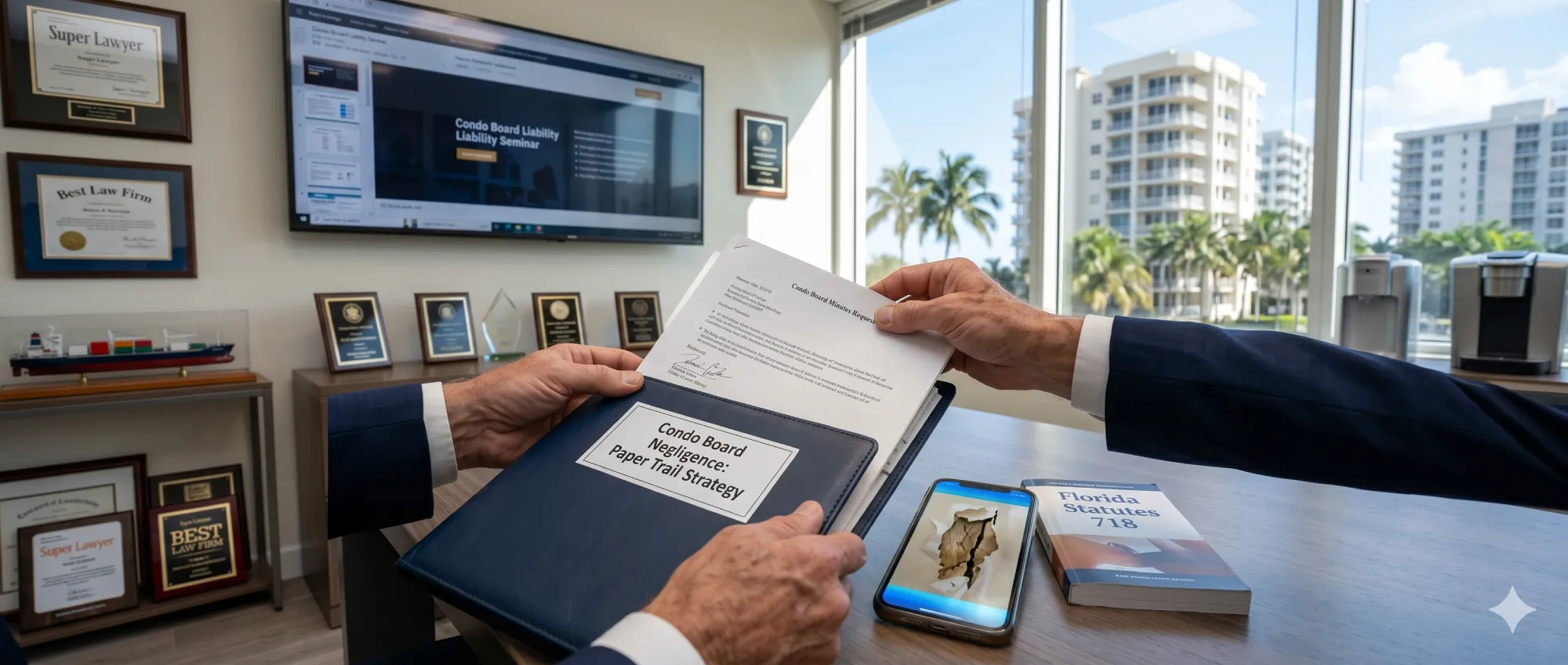
The “Paper Trail” Strategy
The best preparation is a “paper trail.” Your silence isn’t just a quiet home; it’s a legal weakness. Here is how your delay impacts your case:
- Mitigation Requirement: For every day you wait, you are legally not “mitigating” your damages. You have a requirement to act quickly. Documentation of mold issues should include photographs, air quality tests, and a formal written notice to the board identifying the source of the mold. Our internal data suggests that a delay of over 10 working days can statistically reduce your potential damage recovery by over 3% for every 10-day block thereafter.
- Proving “What Caused What”: When you call us, we fight with strategy. But if you wait too long, it becomes much harder to create a clear timeline that shows the board’s negligent act is what caused the mold. A professional mold assessment by a licensed expert is crucial to properly identify, document, and establish the extent and source of the problem, ensuring your case meets legal and regulatory standards.
Action Steps for Building Your Paper Trail:
- Take clear, dated photographs and videos of all affected areas.
- Obtain a professional mold assessment from a licensed expert.
- Send a written notice to your association or board, detailing the problem and requesting immediate action.
- Keep copies of all correspondence, reports, and receipts.
- Follow up regularly and document all responses (or lack thereof) from the board.
With your documentation in place, you’ll be better prepared if your dispute escalates to court. Next, let’s see how Florida courts evaluate mold disputes.
How Courts Evaluate Mold Disputes
When mold disputes reach the courtroom, judges look closely at several key factors. Courts examine the source of the water intrusion, whether it originated from a common element, and how promptly the association responded to the issue. Under the Florida Condominium Act, associations have a clear duty to maintain common elements and address water intrusion without delay. If the association failed to act or neglected its maintenance obligations, courts are likely to hold them liable for resulting mold growth and damages. The court’s primary focus is whether the association acted reasonably and fulfilled its responsibilities under the condominium act, especially after receiving notice from the unit owner.
Understanding how courts view these cases can help you prepare your evidence and arguments. Now, let’s address a special topic that often arises in mold disputes: emotional support animals.
Emotional Support Animals and Mold
Emotional support animals (ESAs) provide vital therapeutic emotional support for individuals with disabilities, but their legal protections differ from those of service animals. In Florida condominiums, ESAs are covered by the federal Fair Housing Act, which requires housing providers—including condominium associations—to make reasonable accommodations for residents with a disability-related need. To qualify, owners must submit documentation from a licensed mental health professional supporting their ESA request. In mold disputes, the presence of an ESA can influence the association’s response, as mold growth may impact the health of both the resident and their assistance animal. While associations must accommodate ESAs under Florida law, owners are also responsible for maintaining their unit to prevent mold and ensuring their ESA does not pose a direct threat to others.
Compassion Beyond Condo Mold
Our expertise-based advice doesn’t just stop at structural issues. We bring the same level of precision and purpose to helping clients with Emotional Support Animal (ESA) and Service Animal requests. We believe every client deserves a champion, whether it’s against a negligent board ignoring mold or one that’s getting the law wrong about assistance animals.
When requesting an ESA or service animal accommodation, it’s important to understand that a valid emotional support animal letter (ESA letter) must be issued by a licensed healthcare provider who has personal knowledge of your condition, in compliance with Florida statutes (section 760.27). Under the Americans with Disabilities Act (disabilities act) and federal law, service animals are defined and protected differently from ESAs—service animals are trained to perform specific tasks for individuals with disabilities, while ESAs provide comfort but are not granted the same public access rights. However, both are protected in housing under the Fair Housing Act and Florida statutes, which limit associations’ ability to enforce pet restrictions on assistance animals and require reasonable accommodations for those with disabilities.
Did you know that about 60% of all housing discrimination complaints in Florida are related to disability and support animal requests (HUD, Florida Housing Data)? This shows that boards are often getting the law wrong. If your board tries to treat your necessary assistance animal like a simple “pet,” you deserve clarity and compassion from a dedicated advocate.
10 Most Common Questions Asked to Florida Condo Lawyers About Mold Disputes
Below are the most frequently asked questions, each with a clear answer to help you navigate your rights and responsibilities.
1. What if my board refuses to show me common area inspection reports?
Under Florida Statute 718.111, you have a right to inspect records within 10 working days of a written request. If they refuse, we counsel with empathy to help you.
2. Does my “official” records request have to be certified?
No, but it must be in writing. The board owes $50 per day up to $500 if they do not provide access (Florida Statute 718.111(12)(b)).
3. Is mold always a board responsibility?
Responsibility depends on whether the mold affects condominium property (common elements) or personal property within your unit. Generally, if the source is from a “common element” (like the roof or standard pipes), the association is responsible, and their insurance typically covers damage to common elements such as drywall and structural components. However, your HO-6 policy covers your personal property and interior finishes. If the mold originates from your own plumbing or inside your unit, it is the owner’s responsibility to remediate and repair, including ensuring proper ventilation to prevent mold growth.
4. Can I sue my condo association personally?
You can sue them for not doing their job. Our highly rated firm fights with strategy, not just file motions.
5. Do I have a right to have my ESA in a “no-pet” building?
Generally, yes, under the federal Fair Housing Act and Florida law. They must make a “reasonable accommodation.”
6. Can the board force me to pay for a mold remediation?
Only if they can prove you caused the problem. If the mold originates from a source inside your unit, such as a leaking appliance, the owner is responsible for all remediation and repair costs.
7. What happens if my neighbor’s mold affects my unit?
That gets complicated, but we bring precision and purpose to untangle it. Property managers often coordinate remediation efforts and handle disputes related to water intrusion between units. Issues with exterior waterproofing, if neglected by the association, can also lead to water intrusion and mold damage.
8. Can I break my lease because of mold in a condo?
If you are a tenant, you might have strong rights under Florida’s landlord-tenant statutes.
9. Should I use an air quality test or a mold inspection?
A professional mold inspector is usually better, as they find the source. Any visible mold growth should be documented. Florida law requires that the same company cannot perform both mold assessment and remediation on the same property within a 12-month period to prevent conflicts of interest. Additionally, professionals handling mold issues larger than 10 square feet must hold separate specialty licenses from the DBPR under Chapter 468, Part XVI of the Florida Statutes.
10. Do I need a lawyer for a mold dispute?
If the system feels overwhelming, an expert advocate is your best protection to restore what’s been lost. Note: Negligence-based claims in Florida have a four-year statute of limitations, while breach of contract claims typically have five years.
Restoring Peace of Mind With Strategic Representation
At The Law Offices of Herb M. Milgrim, P.A., we restore dignity, stability, or peace of mind. We have spent decades helping individual unit owners in Fort Lauderdale, Miami, Hollywood, Hallandale, and Aventura who are facing overwhelming situations. When you feel the system is heavy against you, you need an expertise-based, authoritative, and trustworthy champion. Call us today.